


Show Notes
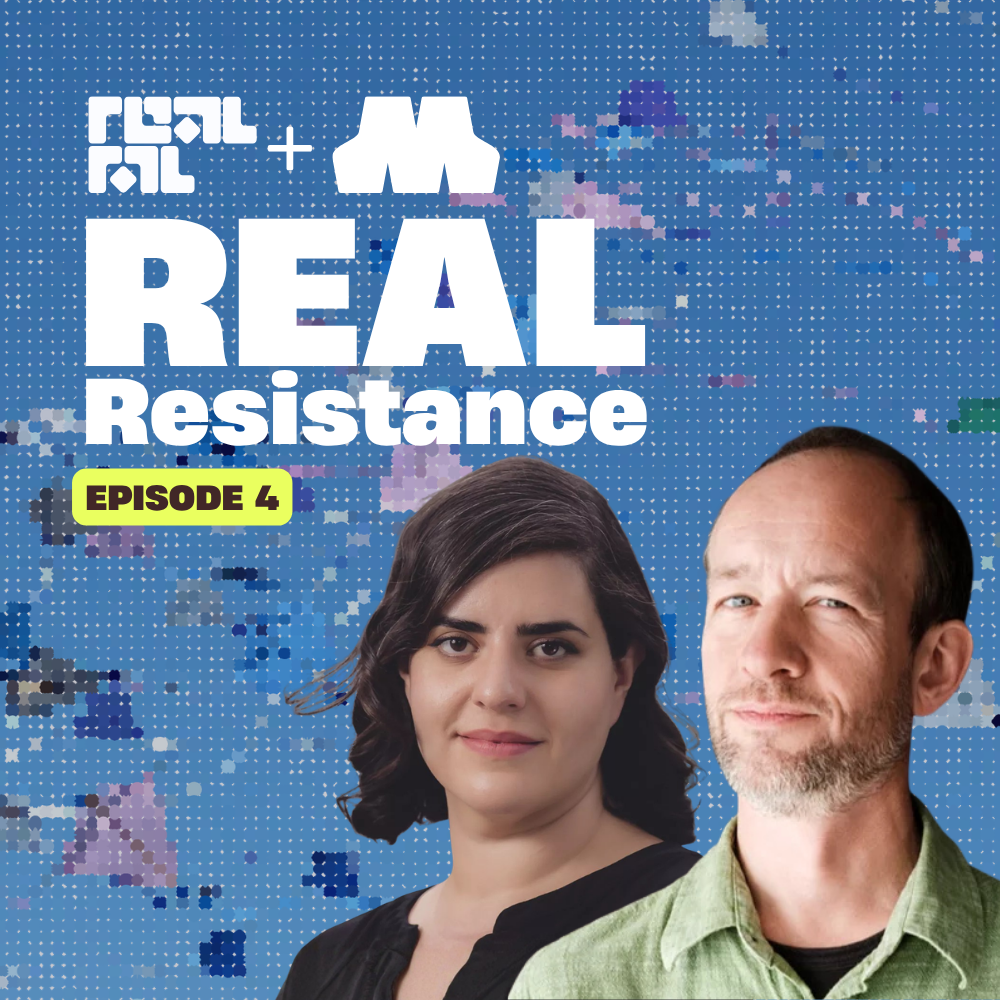
Mariel Garcia-Montes and Crofton Black share their stories and investigations that uncover the backdoor deals that allow the surveillance industry to thrive under the guise of ‘security’. If you have nothing to hide, you won’t mind if we spy, right?
More like this: REAL Resistance: The Global Fight Against Technocolonialism
This is REAL Resistance, a collection of conversations produced in collaboration with Real ML, featuring the experts and advocates who make up Real ML’s global network.
In this conversation, two guests from the network take us on a guided tour of the global underground surveillance tech market:
- Mexico is the world’s biggest importer of surveillance tech, and has a rich history of spying on citizens. Mariel Garcia-Montes briefs us on that history and what it means for Mexico now
- Surveillance technology represents a global industry that is mediated by exclusive conferences and backdoor deals; Crofton Black has spent years investigating this industry, the players, and the vulnerabilities they exploit
Further reading & resources:
- More about Mariel’s work
- Surveillance Secrets — Lighthouse Reports, 2025
- Ghost in the Network — Lighthouse Reports, 2023
- More on the Mexican Student Movement of 1968 — Eugenia Allier-Montano, 2022
- The Tierra Común Network, which Mariel invites any scholars and practitioners to join
Join The Maybe Collective to explore the politics of technology through fresh ideas that you won't hear anywhere else. Sign up for monthly insights, access to exclusive digital events, and real ways to get more involved on issues you care about.
Computer Says Maybe is produced by Georgia Iacovou, Kushal Dev, Marion Wellington, Sarah Myles, Van Newman, and Zoe Trout
Transcript
Mariel: [00:00:00] The expectation when you say, "Oh, there are birds on the wire," is not that the person or the entity surveilling you will go away. The expectation is for you and your interlocutor to self-censor.
Crofton: What Ghost in the Network did is kind of expose the globalized set of loopholes and how people are weaponizing them, how people are getting access to them, and show what ends in Mexico passes through many, many places.
Alix: A mere handful of tech companies have enormous power over the systems we rely on, but the conversation about how these companies impact people are really vague and superficial. We need to hear from experts and advocates focused on understanding what's actually happening, knitting together a global understanding that empowers resistance.
Welcome to Real Resistance, a series produced in collaboration with Real ML, the network doing just that. We're talking with members of that community who have the receipts, the stories, the research, the insights to build a future that isn't governed by [00:01:00] tech billionaires. And in this conversation, we're examining the culture of acceptance that surrounds the surveillance industry and the backdoor deals that allow these technologies to proliferate globally.
Mariel: I'm Mariel Garcia-Montes, and I'm a PhD candidate in MIT's doctoral program in history, anthropology, and science, technology, and society. I am a researcher of media and information technology, especially as they contribute to the public interest and social change.
Crofton: Hey, I'm Crofton Black. I'm an investigative reporter and editor at Lighthouse Reports.
I've spent most of the last seven years or so looking at surveillance technology, at the companies who sell it, at the way it's used, and the people who have been affected by it.
Alix: Starting with you, Mariel, your work is at the intersection of lots of things, um, but I think in the context of your ReelML work, looking specifically about the history of surveillance tech in Mexico and kind of how that has [00:02:00] evolved historically, and I wonder if you wanna just kind of take us through that exploration.
Like, what kinds of research questions are you asking? What types of methods have you used to better understand some of those histories?
Mariel: I'd like to share a little bit about my origin story, which is that I worked in digital rights civil society in Mexico with some of the journalists affected by the technologies that Crofton and I will be speaking about today.
And so for me, it was a purview into some of the narratives that I knew had taken a shape that maybe didn't represent what I had seen in the field, and also just trying to understand how is it that my country, Mexico, had succeeded in allocating these millions of pesos in, in such an unequal country to really acquire really expensive technology to surveil dissidents and to act on behalf of other powers as well.
And so for me, that was the starting point of my research. And then working with top historians of computing [00:03:00] in, in my academic program, of course, I ended up all the way back in Napoleon III, and just, like, the really early origins of how Mexico built its capabilities to To acquire technologies of control and use them against its people.
But it's, as I said, it takes just back to Napoleon III, which maybe we don't have to for the purposes of, of this short and sweet podcast. I do want to talk a little bit about exactly how it played out in institutional history of Mexico that we have these acquisitions and that we have these legal frameworks that the country created, that the government created to allow its government to, again, import technologies and to weaponize them against dissidents.
In the 1930s, when the country began to regulate what it called electric communications, so-called electric communications, they did designate private conversations over mediated channels like telephony as confidential. [00:04:00] However, they also did say that operators had to comply with government searches. And so they created very early on this framework that allowed the Mexican government to approach the one telephony company, so a monopoly compared to other countries which allow this operation to run much more smoothly.
And then within the government, it, you know, the different intelligence services that ran within the Secretary of Interior were the authority that was tasked with running these wiretaps. And so in practice, what it looked like in the '40s, '50s, and onwards was that they had agents at the telephony company, so they were limited by how many agents they had.
They started out with two, then they had six, and it was real time listening. It was not recording to process later. And so you can find in the archives some of the transcripts of these wiretaps and, you know, the very high profile cases that they were used on. For example, the murder [00:05:00] investigation of a Cuban secret police agent in the Cuban embassy in Mexico, and it's full of wiretaps and transcripts that the agents wrote down as these calls were taking place in the 1940s So that is one.
The other one is how it created the capabilities for importing foreign technologies of control, and a lot of it has to do with Mexico's regulations on gun imports. So President Lázaro Cárdenas in early World War II decided even though there's this right in Mexico to own arms, there isn't that right to bear them in public unless you're part of the military or the police, or you follow with certain regulations.
And so President Cárdenas at the start of World War II, through a decree, a presidential decree, issued that there would be a temporary halt of the import, manufacturing, sale of guns in the country, basically to stop society from proliferating guns in [00:06:00] Mexico. The interesting thing that happens in this decree is that he creates a category called the special designated import, a control of import that only certain parts of the government can use.
And so it is in practice this special import permit that the secret police then uses decades later to import anti-riot gear in the 1960s to use it against, uh, the students and the people protesting on the streets. So this really well-meaning instrument to stop gun proliferation then gets exploited, of course, in government fashion, to allow the government to make certain imports that might be shady, and say that because they are for national security purposes, this one authority, the secret police, can import them.
And I think that that really brings us to the present day and the technologies that Crofton has been investigating. That is how it began a few decades ago. One of the, and I think honestly, kind of misunderstood [00:07:00] episodes for even civil society in Mexico working on privacy issues, has to do with the origin of the largest biometrics database in the country, which in the present day, in 2026 still, but this might change soon, unfortunately, this database cannot be used for training purposes, for AI training purposes.
It cannot be used by the government as a corpus to train its imported facial recognition-enabled cameras. It cannot be used by other authorities beyond the Electoral Institute, which is the custodian of this database. And the way that came to be in the '90s, so fairly recently, speaks to a very specific moment in Mexican history where the country was grappling with the aftermath of electoral fraud and the collapse of trust in institutions, in democratic institutions.
And so all of the parties came together to create an institute that would [00:08:00] oversee the elections, which had been previously overseen by the government And also, which was tasked with creating a national database, the voter registry, which would also include the photograph and fingerprint of the people who registered.
This was just before 9/11 and the boom of facial recognition technologies in the US and worldwide. So maybe if this had happened in the 2000s, maybe this privacy miracle wouldn't have happened. But at the time, in the '90s, because their threat model was the collapse of democracy, they said, "Under no circumstances should the government access this data.
It's under the custody and protection of the electoral authority." And because this was codified even through the Constitution, to date, the government cannot access it, although President Claudia Sheinbaum's a- administration is, is trying to find a different way.[00:09:00]
Alix: This slow erosion of governance that has allowed for the protection of people from kind of, I don't know, no-holds-barred surveillance in Mexico. I don't know. It feels like two tracks, this dissident track and this general public track, or this desire to build this infrastructure, and I know, Crofton, you've worked loads on well-resourced, targeted attacks using emerging technologies against dissidents, against journalists, against basically anyone who is perceived to be an enemy of certain nation states who are willing to set aside any legal protections or carve out legal environments where they're allowed to do some of these things.
But do you wanna talk a little bit about, uh, how these surveillance companies that you investigate figure out who they can partner with? Like, it... They obviously can't just post up on the internet and say, "Here's a product for sa- for sale. Um, come one, come all nation states that are interested in targeting local journalists."
Um, how, how does, how does this marketplace function? [00:10:00]
Crofton: There's some pretty highly developed ecosystem of actors who are selling different types of surveillance technology, and that includes technology to identify people's locations. It includes technologies to take over their phones, to listen in on their conversations, to look through their social media, to look through their files, take over their internet accounts.
The way that we kind of approached this when my team at Lighthouse Reports was looking into this for what became ultimately the investigation we called Surveillance Secrets is We kind of wanted to go to, like, a hub where all this stuff was going on, and the hub that we chose was this thing called ISS World, which is a series of conferences.
And ISS World is probably, you know, the biggest and certainly, I guess, certainly the most, um, notorious get-together of surveillance companies and the people who are their clients, would like to [00:11:00] be their clients. And it happens several times a year in different locations. So in every kind of three months or so, there's an ISS World happening somewhere.
It is, to a certain extent, like a training event, so it's actually called ISS World Training. That's what, that's what its, um, full title is. The idea is that police and intelligence officials can go to this thing, and they get to sit in a seminar room for a couple of days, and they have, like, introductory talks and then rather more advanced talks about particular technical issues like, how do you de-anonymize someone who's using a Tor browser?
How do you manage to, um, figure out, you know, the identities behind people doing cryptocurrency transactions? And this is the kind of ostensible agenda of the thing, but I mean, basically, it's a marketplace. This is where customers and companies meet, and they talk. You know, the customer might attend a presentation, and then they're [00:12:00] gonna book, like, a kind of person-to-person meeting, and it's kind of like, "What can...
You know, what can you do for us?" And what we found is, you know, normally journalists and civil society are not invited to this thing. They don't want them there. And what that means, obviously, if you do manage to get in, is that the conversations are kind of surprisingly candid. And so when we set about trying to do an undercover approach to this event, we basically wanted to create a risky character, because we're all familiar with this mantra that both governments and technology vendors are always repeating, which is, you know, "This stuff is for the most serious crimes.
This is, like, for catching terrorists. This is a tool of last resort. This is what keeps people safe." Like, this is the whole thing, the rhetoric behind the buying and selling of these tools. So when we went in there, we wanted to create a character who would basically arrive, like, festooned with red flags saying, you know, "If you're a legitimate seller, [00:13:00] you don't wanna be dealing with this guy because he's clearly, like, coming from a different end of the spectrum."
And they still spoke to him. You can see some of the footage that we turned into a little film at the end of it where, like, they are basically happy to talk to him about pretty much anything. And I think the reason I wanted to kind of give an insight into this is, is exactly because it's such a prevalent myth that this is, like, a heavily regulated, either regulated by law or self-regulating by ethical practices, like, this is a heavily regulated marketplace.
Once you get into that marketplace, I can tell you that is not what it looks like, and that is not what the conversations that are going on in there sounded like at the time. So obviously, post factum, there are legal commentaries that we have from these people that say things like, "Oh, well, in a nutshell, that conversation was not intended to be taken seriously."
That is the legal caveating that surrounds this. But judge for yourself. You can hear the [00:14:00] tape where these guys spoke to our undercover reporter about the best ways to set up a shell company to mean that they could sell technology to sanctioned entities in Africa, for example. I did not get the impression listening to those tapes that these executives thought they were doing anything, like, particularly crazy or unusual by the standards of the industry.
That's not what it felt like to me.
Alix: I wonder, I mean, going back to Mexico, would you be willing to talk a little bit about the Ghost in the Network investigation and sort of when we kind of take this global marketplace and then think about how these technologies are deployed in a particular context and used in a particular way? I think that's, uh, maybe helpful for some people to understand the kind of trail of acquisition of these technologies and how they're being used.
Crofton: Yeah. So Ghost in the Network, it's one of those investigations that began with a tip-off really. I got a phone call one day from a source. This person said, [00:15:00] "Last week a journalist was shot dead in Mexico. You should look into this because you're gonna find that before they were shot, there was an attempt to pinpoint their location using a telecom network vulnerability."
What we found was something, you know, in some ways something quite profound, which is we pretty much traced the provenance of the query, the packet, the signaling message, whatever you wanna call it, through like a whole series of steps in terms of how it got to this guy's phone. And what we found was this real kind of crazy worldwide network of essentially taking advantage of long-standing vulnerabilities in mobile phone infrastructure.
And in this particular instance, the links in the chain included the Pacific island of Fiji, which is one place that the phone infrastructure that was used to like try and [00:16:00] locate the guy in Mexico actually came from Fiji. Why Fiji? Well, that was a link in the chain that was established by a guy in Switzerland.
Like, he was the kind of core of the key node in this network, if you like. He had customers. I mean, he maintained that he knew nothing about this, and it was-- must have been one of his customers who was doing this. He wouldn't tell us who his customers were, but we, we established that amongst his customers, there were several surveillance technology vendors based in Israel.
There was a company called Rayzone, which has kind of relatively long-standing links to Mexico in various ways. Rayzone was a client of the Swiss guy whose name is Andreas Fink. Fink had leased a bunch of basically what they call global titles, which are like access points to phone infrastructure. He'd leased them in Fiji, also in like Vanuatu, Papua New Guinea, other places in the South Pacific.
He was routing messages through these places on behalf of his clients And he was also doing a bunch of other stuff around the world where he [00:17:00] was basically kind of going around the place looking for access to phone networks. So now at one point we got hold of a confidential chat he'd had with a guy who worked in a phone company in Africa where he basically just hits up this guy on LinkedIn and he was like, "Hi, can you sell me access to your phone network under the counter?"
That's not literally what he said, but that's the import of what he asked for. And the guy was like, "Well, why?" And he said very candidly, like, "I have clients who want this access. Some of them are governments. They wanna track suspects." That's the phrase he used. They wanna track suspects in countries including in Mali this was about at this time.
And he says, "You know, we-- we're having some problems 'cause there are intermediaries who are screwing up our queries." What he's referring to there is like firewall companies and security companies that are kind of trying to stop this wholesale exploitation of phone networks being used to locate people around the world.
And so, you know, it's like he's in a kind of cat and mouse game with the security providers [00:18:00] where they're trying to shut down his loopholes, he's trying to build more loopholes. Ultimately, what Ghosts in the Network did as an investigation is kind of expose the globalized set of loopholes and, like, how people are weaponizing them, how people are getting access to them, and show that, you know, what, what ends in Mexico passes through many, many places.
This is a globalized phenomenon, and the reason it came about does not quite go back as far as Napoleon III, but it does go back to, like, the 1970s, the 1980s, the 1990s, and what happened in the sort of mobile phone revolution in terms of infrastructure and how it was designed, used, which basically means that in a lot of countries, even, like, 30 years later, people are very vulnerable to things like location leaking out to kind of anyone who's got, like, a relatively rudimentary technological stack that they can use to exploit this stuff.[00:19:00]
Alix: Almost all of our information networking is so loosely assembled and also so casually constructed, and the security vulnerabilities are so great, it feels like we basically have... I mean, I feel like, Mariel, you know all about this, but basically that, like, it, it's just, it's just so porous and voluntary and, and, and badly governed that it makes it really ripe for all kinds of surveillance and also just a- anybody acting in bad faith can quite quickly find ways of penetrating these networks in a way that's really...
I think once you know anything about it, it's actually quite terrifying how fragile some of these systems are.
Mariel: As somebody who studies this but also somebody who lived it, just thinking, I mean, as I was listening to Corfton describe these network of intermediaries and the guy in Fiji that works with a guy in Switzerland that reaches these, you know, government officials and sells them these horrible access to technology while also giving them apparently, like, a freebie certificate [00:20:00] of completion of some training, the work that Corfton has done in, and Lighthouse has done in exposing this chain of decisions and procurement and resources globally that get created.
At the time when I was working with my clients, we knew that they were under phone surveillance, and we knew that it was mobile phone surveillance. We did not know how it operated, but we knew because of the kind of leaks that we were witnessing, the kind of information, situations that, that we were living in the day-to-day.
We knew that there was an element of phone surveillance, and it also is very difficult emotionally to manage, maybe less so for myself and more for the people who were directly affected by this. And, and you see a lot of that in the testimonials of Pegasus victims who all remember, and at least as I saw in my interviews, who all remember how they were interviewed, [00:21:00] like, what was the bait that they actually clicked?
This was the SMS bait, right? And to be able to get a full picture of the procurement and the guy who ideated it and the guy who operated it in Fiji, and then also the intermediaries in Mexico that imported the technology and who made money off Of this interest of the government to surveil specific people at a very high cost is something that I think has become also validating for the people that I know who are affected by this.
And many of them, even though their work is not at all in surveillance or, you know, our sphere of public interest technology, have become really well-read in these issues because it speaks to a big part of their lives that they experienced over several years. And so to have such a comprehensive account in the present day, I think is very important and, and I'm just a big fan of Grafton and Lighthouse Report's work.[00:22:00]
Crofton: I really wanna ask about birds on a wire, 'cause this is a thing that came up in our preliminary conversation, and it seems like I wanna have some kind of explanation for this rather striking image and, like, where it comes from, where it went to, how it's used. Like, tell me more about it.
Mariel: Birds on a wire is a Mexican saying that you use in a conversation when you want to tell your interlocutor that you're being overheard.
And so it could mean that there's an auntie listening in or that it's the government listening in. Uh, but the expectation when you say, "Oh, there are birds on the wire," is not that the person or the entity surveilling you will go away. The expectation is for you and your interlocutor to self-censor. And so it, in my opinion, it really symbolizes an aspect of surveillance culture in Mexico, where everybody expects to be, you know, getting listened on during their conversations, be it the government, be it [00:23:00] other people.
It's a very surveillance-accepting culture, in a way. And at the same time, we see with Pegasus, with other technologies, instance after instance, and, and really historically even, with the start of the prominence of World War II wire taps in Mexico, you see opinion pieces decrying the government's intervention of confidential communications.
And so even though you would find Mexican culture to be surveillance accepting, you also have really rich instances of resistance to the surveillance. And I think that this turns Mexico into a global story, perhaps doesn't speak so much to the Global North, but it does definitely speak to other surveillance histories in Latin America and Africa, where you have big economies that are putting a lot of money into these technologies of control, the ones that Crofton's team saw at ISS World.
They probably all had a lot of traction with the [00:24:00] Mexican government, one of the many levels of Mexican government, to understand how these capabilities came to be, how it was accepted, but also how people started to resist it and what were the lines that were crossed in the eyes of people, proves that, you know, countries are not a monolith.
Crofton: It's a great image, and I mean, I just wonder, like, like, how do you visualize it? Like, the wire is a phone wire, and the birds are, like, sitting on the phone wire, and they're hearing the conversations that are going through it? Is it, is it that kind of wire, or do you see it in a different way?
Mariel: I think there is some of that imagery, but I think it's also just the social practice of there is somebody in the room next door, and they are listening in, so maybe this is not when you tell me about your boyfriend, you know?
I think it's a very malleable saying.
I think something that's really brilliant about your work, and, and I know that location-based surveillance has been an object of interest for many investigative journalists around the [00:25:00] world, but by going to ISS World and, and really the international focus of your, of your investigations has given you a purview into what is a global market, not just a sort of local contractor or a US-based firm that turned the mail into a source of information about people and then sold it to us, to the data brokers, but really a global network.
And so this case, I understand you got tipped off by somebody who said, you know, there was a Mexican journalist killed as a direct result of the technologies you study. But I wonder, like beyond Mexico, what are other points of interest, geographically speaking, that you see in this global network?
Crofton: There's a huge power dynamic at play in the geography of it because at the point of origin, like all networks anywhere, are vulnerable to it being possible to gather people's location from them.
You just, you send a specific command [00:26:00] posing as a legitimate network operator, and you get what they call a cell ID back, and the cell ID you can correlate with public databases to a position. But in practice, you can defend against this, and phone companies do defend against it more or less. For them, there's always this balance between, like, how much do we spend to defend and, like, how much do we risk losing by not allowing traffic through?
And the whole economics of it is kind of fascinating because, like, you know, ultimately the more traffic that is traveling, the more money is getting made, and when you start cutting out traffic, then to an extent you're cutting out money. And thus, just on the kind of face of it, in the global majority Phone companies will typically not have so much money.
They might be operating on slimmer margins, and thus they are less incentivized to offer these protections, whereas in the wealthier countries, it might be more normal, [00:27:00] say in like the UK or Germany or whatever, like you might expect a slightly more protected phone infrastructure from your provider, right?
But I mean, that's kind of a problem because the people who are most at risk from this type of surveillance are typically not wealthy Western countries. Although, as we showed in the Surveillance Secrets investigation, there are exceptions to that. So, you know, we, we did a story about a guy who was in Italy who was an investigative journalist, and he got tracked.
But the other side of the coin is kind of more, to an extent, more problematic is also that what you do see is networks in wealthy countries being used and weaponized against people in the global majority because those companies in Europe or whatever, I guess, have an appearance of being more legitimate as a source of traffic.
So when you're kind of shopping around looking for, um, how are you gonna, like, get your communications queries sent into [00:28:00] a network, it's kind of particularly problematic to my mind that there's this geography at play here where Quite often what you see is the real premium access is like, can you get hold of Switzerland or Sweden or the UK and use that as your conduit to go in to find victims in the majority world, right?
Because this is like a downstream problem where the problems are actually happening not on the doorstep of the companies that are creating it; they're happening somewhere else. And when you talk to phone companies about security, they always think it's their customers' security you're talking about. If you talk to a phone company in Sweden or a phone regulator in Sweden, they will say to you, "We do our best to protect Swedish people against these types of vulnerabilities and attacks."
But that's not really the problem here. The problem is Swedish networks being weaponized to attack people in other countries, countries which are less well able financially and in terms of infrastructure to [00:29:00] protect themselves as the Swedes are. And trying to get people to sort of understand this global dimension has been really one of the things that we've done in the series of articles we've done on this.
And so that's kind of like you asked me, what are the kind of focal points geographically? For me, actually, the focal point is like, how do we one by one chop off the supply in the wealthy countries so they're no longer essentially information pollutants in the countries where people are more vulnerable, more at risk, and need better protections that their phone companies kind of can't afford?
It might be tough to say to a phone operator operating on a small margin in the Global South like, "You need to pay more money and pass the costs onto your subscribers to protect them better." But it should be relatively easy to say to a phone regulator in Europe, "You need to stop allowing these guys to just lease out their access to all and sundry, [00:30:00] proliferating this kind of problematic behavior around the world."
So for me, in terms of the way I view this, that's kind of what I'm trying to do
Mariel: I don't know if I can abuse my, my powers as a participant in this podcast to also pose an optional question to Alix about this because so Crafton is like giving us these really nuanced and comprehensive and also complicated picture of what surveillance operations really do look like in the daily around the world.
And a lot of the advocacy, not just in the Global North, I would say partly also in the Global Majority Seems very, you know, I guess we all have to focus on a, on a context, right? But it's very difficult to strategize and to come up with, you know, things that we can advocate for and, and do that really represent or tackle a part of this global reality.
And so I wonder for Alix, who, who does a lot of this work with, with funders and movement building with, with the [00:31:00] organizations that are behind this advocacy worldwide, how do you find it in your experience that... Like, is it hard to communicate these complicated reality, or would you say that by now, 2026, foundations have more awareness of this?
Like, how, how is it in, in terms of the movement building?
Alix: Yeah, I mean, I would say two different communities, one being philanthropy and two being people that know things. No, no shade, um, on foundations, but I think that they oftentimes are so broad and allocating resources that are so limited in, in comparison to the global s- shape and size of the problems they oftentimes work on, that what they're doing is essentially creating a global logic to some of these problems by putting resources in a particular place.
People come to those resources, and then they're in relation with each other. And so I think actually the money that philanthropy gives out functions to kind of reveal networks in a way that I think is really interesting [00:32:00] and helpful because it sort of shows a complementarity of work that you might not see if you weren't juxtaposed by people that were kind of looking top-down at some of these bigger picture things.
They're thinking about the two of you, like a historian and academic and former and current activist paired with an investigative journalist who is uncovering the kind of, the stories that help people understand what's really going on and kind of insights into the inner workings of some of the adversaries that, um, you might be interested in working against.
But those kinds of interdisciplinary moments and networks are, to me, essential and also what's really powerful about both global efforts, movement building, philanthropy. Um, I think that the underlying complexity of any one issue, though, is so great that the idea that any person or program or network can entirely deal with even one of these things, like looking specifically at targeted [00:33:00] surveillance technologies deployed by nation states against journalists and activists.
It's a very pernicious, important issue to work on, and, but it's also one of, like, 10,000 issues, and if you kind of peek under the hood of this one issue, it's like, explodes in complexity. Like, it immediately is like, "Oh, how do you-" govern global technologies? How do you incentivize global north countries from exporting these technologies?
How do you prevent other nation states from procuring these technologies? And I think that there's just, there's so many tactical challenges in each of these areas. And so what I have seen, where I have seen success is when you combine and build community between disciplines, but people that are really focused on something specific, uh, that's tactically essential to, like, work on, like surveillance technology and targeted surveillance of, of journalists using network vulnerabilities.
Um, and then you create specialized structures and communities to work on that. I was really heartened by the fact [00:34:00] that NSO group was targeted legally, and that targeting was resourced by WhatsApp, um, because it's a, it's also a corporate prerogative, and I'm not saying that we should just go and be friends with a bunch of companies, but I think there are all these really interesting moments where you can use, like, the enemy of my enemy is my friend or something.
I don't know. Um, so I don't know. I, I f- I get overwhelmed quickly by the complexity, but also enjoy the complexity. I don't think there's that many people that are as sick as me and enjoy, like, getting into the weeds of like all these different areas, and then trying to kind of knit them all together in something meaningful.
But I do think there's a growing number of clear networks working on clear things that are important to fix, and that when you kind of zoom out, there's this beautiful network of networks that I think has developed over the last, I would say, 10 years, um, that just didn't exist before, where you have these specialisms, but that they're connected with other specialisms.
And I also think it's dramatically underfunded. Like, I think that when you get into these particularly, like, emerging [00:35:00] intersectional areas, geographically intersectional, thematically intersectional, there's just... It's, it's the labor of people like Real ML who kind of have a vision of networking these spaces, and it's not very well-resourced, I think because it requires you to kind of have a bigger picture while also maintaining that kind of expert level interest in the detail.
So I don't know. I feel very hopeful because I get to spend a lot of time with people that are brilliant and working exactly on the issues that need to be worked on. But I also think foundations and philanthropy worlds, and just people in general need to be better at seeing the importance of some of those connections.
You know, like seeing what happened with RightsCon, that's why it was so disappointing, 'cause I think those are the places where you get the rela- you build the relationships and that connective tissue between strategies that is so essential to be effective when we're kind of under-resourced in comparison, a- and asymmetrically, and our adversaries are, I don't know, big.
Those are my thoughts. Basically, you're doing God's work, and I wish you had more resources to do
Crofton: [00:36:00] it is my conclusion.
Mariel: And you can donate to Lighthouse Reports in the cl- in the link here.
Crofton: Yeah. Totally. Totally, totally. We'll add a, we'll add a, a donate button for Lighthouse Reports.
Alix: So I don't know. I mean, Crofton, I'd be curious when you think about the kind of cutting edge investigations of journalists that you see going into these machines and coming out with insights and understanding and stories, like are there lines of work that you wish were more resourced, or are there investigations that you're particularly excited about or things you wanna see?
Crofton: It's kind of a, a crazy moment right now because something quite unprecedented is happening in the world of technology, and no one knows how that is gonna affect global economies. Potential, like, extreme disruption is possible, but, like, no one knows what shape or form that's gonna take. And it's only relatively recently, I guess, in my kind of career arc that I've sort of become a, a [00:37:00] technology, a technology reporter, right?
That's not what I set out to be, and it's not kind of what I was doing for quite a long time. But I think we're in a position right now where it's like every question is ultimately like a tech question right now. Every type of beat of, like, every kind of investigation that you might have going on is increasingly having some sort of tech angle to it.
Certainly, that seems to me to be the case. We don't have any kind of guide to, like, what actually is going on right now in the world of large language models, in the world of AI generally. What we do have is, you know, the sort of stuff that I've been interested in looking at in the last few years basically comes down to one word, which is infrastructure.
If you wanna understand, like, what a large company is doing, then the best way to try and do it is to understand the infrastructure underneath it, and that's kind of how I try and do investigations. So I wasn't particularly setting out to understand, [00:38:00] like, how a particular apex surveillance vendor works.
I was setting out to understand what is the network of small service providers underneath it that is kind of creating the information flow and the cracks that it can flow through that make this kind of, um, exploitation of data possible. And I think the same thing is gonna be true of, like, even these global, like, behemoths and colossal companies, whether that's Anthropic or OpenAI or NVIDIA or like, you know, whatever.
There's gonna be a massive infrastructural footprint of other entities that are servicing them. They're gonna need it, and to me, that's interesting. If you can identify the kind of infrastructure footprint, that's a happy place to be, investigations wise. That's what I think.
Mariel: I agree entirely, and I think that a, a beauty-- I mean, it's, it's a very difficult moment, and I don't want to underplay at all how, how difficult it is for people graduating into a recession with concerns about AI and the displacement of labor, of human labor.
Of course, labor and [00:39:00] infrastructure, infrastructure especially in terms of data centers and infrastructures of computing that have health and, and economic and all sorts of impacts for the people who have the experience of living near them and, and having one suddenly pop up in their backyard, I guess.
Those two are fields that really prove to us that the concerted effort to shape the conversations on AI ethics, in my opinion, has failed. I think that it is true that, of course, you see a lot of discourse around AGI and alignment and existential risk and, you know, this agenda f- this corporate agenda to co-opt AI ethics might have succeeded in a very narrow field.
But we see in society at large a response that really shows that people are invested in these issues because it's the future of the world. It's our vision of humanity that is at stake. To me, it's a very important moment where [00:40:00] societal investment in this conversation and these discussions through regulation, through infrastructure decisions, through commercial decisions, individual and national and community level really does prove that however, you know, big and consistent corporate efforts to co-opt the conversation have been, they have not succeeded.
And it really is all up for grabs. And I think that this is a very important moment for scholars, for investigative journalists, for regulators, for people at home, for everyone to have a say, to have a voice about how they want humanity to be and how they want our tools to serve us. To other scholars who might be listening to this and who are invested in the social implications of computing and surveillance technologies, especially in the global majority, to extend to them an, an invitation to the Tierra Común Network, which is a network of scholars and practitioners that, that really thinks about technology through [00:41:00] decolonial terms and trying to think of the global majority, not just the Western models for computing and society.
Crofton: Yeah, I was thinking about this just in the run-up to this conversation. So Like when I first went to Real ML, which was the first gathering that they did in Berlin, this was pretty much kind of the beginning of my real period looking at tech reporting. It was the first time that I was in a room with a bunch of people who were coming from diverse methodological backgrounds, including like some were-- There were civil society people, there were people who, um, were engineers, there were people who were using a lot of freedom information requests, there were people doing data analytics, like all in the same room talking about kind of critical approaches of looking at technology.
You know, that was a new space for me. It's a space which has managed to create and maintain like a high degree of trust, I would say. [00:42:00] As a reporter, you tend to be a little on the paranoid side about sharing your, you know, sharing the stuff you're working on, like talking to people about your methods, about your sources, stuff like that.
Kind of goes with the territory. But like I've always found it, I feel confident talking to people who are in the Real ML family about, you know, work past, present, and future. And you know, that's not a given. It's kind of amazing that they've managed to create and maintain that space. That's what I would think.
Mariel: It's been a long life in academia for me now. It's been 10 years, and it is the best job I ever had, and also simultaneously, it's something that if you're not careful, really does take you away from everyday life and certain types of research, especially the one I do in archives and historical can take you away from the present day.
And so sometimes I'm a little bit hesitant to come back to civil society spaces because I know that I just don't have anything to offer the way that certain, you know, [00:43:00] investigative journalists certainly do, right? And in Real ML, I found the most supportive, creative, and open environment where my early stage ideas of this archival trip I had done in Mexico really, you know, got so much feedback from all sorts of stakeholders, from journalists to activists and designers.
And I felt for the first time in a long time, like my work can matter for the present day, not just for a historical account. And so I am forever grateful to Real ML for fostering that sense of opportunity and vision for public interest work.
Alix: You guys are such good communicators. Like, it's so... I mean, I know you both know that 'cause it's, like, your job, but you are just really good at telling a good story and also being so precise with language, and it's really nice.
Crofton: This is true, Mariel, no doubt. And I- [00:44:00] Yeah ... from, from when we first, the first time we, we had our little meeting a f- few weeks ago, I was like, "This is gonna be cool because, um, Mariel- Yeah ... is so interesting, and she says such interesting stuff. I'm really looking forward to this." Um-
Alix: Yeah.
Mariel: Thank you both, guys.
I'm sweating. I'm dying. Love you both.
Alix: Thank you again to Mariel and Crofton for joining us. This series was produced in collaboration with Real ML. For the past six years, Real ML has brought together people around the world working to challenge the power and inequities built into AI systems, not just through critique, but also through practice.
And many of the people you hear from in this series met or developed their work directly through Real ML workshops where ideas are tested and collaborations are formed. And actually, last year someone said soulmates were found. I've also served on Real ML's board, and it's one of my favorite communities, and I mean that sincerely.
I really love any time this group of people gets together because magic always ensues. And to learn more about Real ML and future workshops, you can check out the link in our show notes. A special thanks to Anna [00:45:00] Bacciarelli, Isha Keegan-Nushabadi, and Shazeda Ahmed from Real ML. And thank you to our production team, Sarah Myles, Georgia Iacovou, Kushal Dev, Marion Wellington, Van Newman, and Zoe Trout.
Stay up to speed on tech politics
Subscribe for updates and insights delivered right to your inbox. (We won’t overdo it. Unsubscribe anytime.)

