


Show Notes
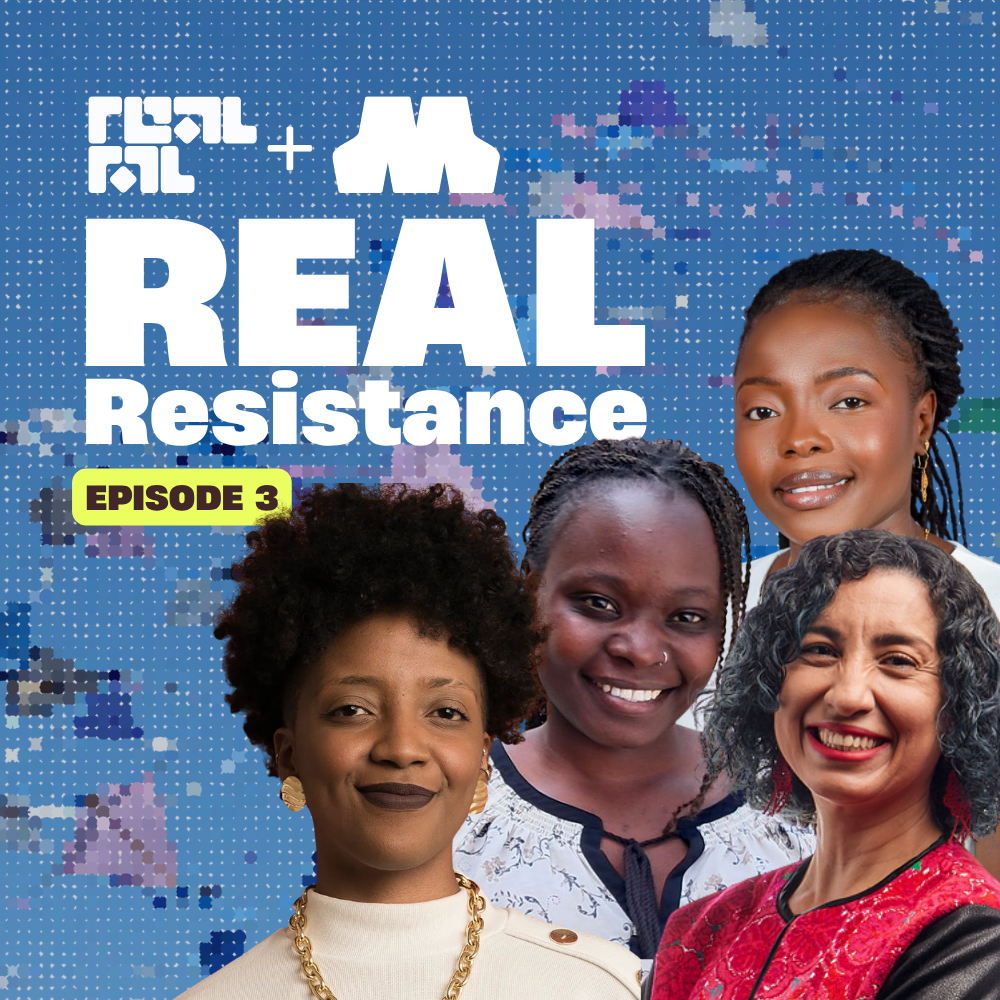
Paola Ricaurte Quijano, Fernanda Rodrigues, Angela Chukunzira, and Kauna Love Malgwi make it clear that colonial powers have never gone away. The people and technology powering them have just changed, and one of them is AI…
More Like This: REAL Resistance: Against Automated Governments
This is REAL Resistance, a collection of conversations produced in collaboration with Real ML, featuring the experts and advocates who make up Real ML’s global network.
In this conversation, four guests from the network discuss how the business of AI continues legacies of colonialism in Brazil, Mexico, and Kenya:
- AI companies are taking land in Querétaro for data center expansion, and they’re doing it without asking first. Paola Ricaurte Quijano explains that these are the mechanisms of dispossession at play — and it’s nothing new.
- The government in Brazil are adopting a risk-based approach for AI regulation; Fernanda Rodrigues demonstrates the problems with this approach, and how they disproportionately harm Black people.
- African data workers suffer the worst mental health harms when compared to other localities. Angela Chukunzira and Kauna Love Malgwi have worked to build a resistance movement for oppressed workers, and a framework for decolonising mental health.
Further reading & resources:
- A Mental Health Intervention for Data Workers — Kauna Ibrahim Malgwi
- "It's not drought, it's plunder" Querétaro, the valley of data centers — By Paola Ricaurte Quijano and Teresa Roldán Soria, July 2025
- Facial recognition surveillance in São Paulo could worsen racism — Al Jazeera, 2023
- The Feminist AI Research Network
- More about the African Content Moderators Union
- Iris — The Institute for Research on Internet and Society
- Siasa Place — a youth organisation that helped tech workers who had been dismissed
**Subscribe to our newsletter to get more stuff than just a podcast — we run events and do other work that you will definitely be interested in!**
Computer Says Maybe is produced by Georgia Iacovou, Kushal Dev, Marion Wellington, Sarah Myles, Van Newman, and Zoe Trout
Transcript
Angela: [00:00:00] What is the cost of our revolution? Every industrial revolution has come at the cost of people, extractivism, labor, and it's always a certain class of people, the second-class citizens, the global majority, actually. So the cost of our revolution is surely subordination.
Alix: A mere handful of tech companies have enormous power over the systems we rely on, but the conversation about how these companies impact people are really vague and superficial.
We need to hear from experts and advocates focused on understanding what's actually happening, knitting together a global understanding that empowers resistance. Welcome to Real Resistance, a series produced in collaboration with Real ML, the network doing just that. We're talking with members of that community who have the receipts, the stories, the research, the insights to build a future that isn't governed by tech billionaires.
And in this conversation, we're exploring the colonial infrastructures that persist in Mexico, Brazil, and Kenya, and how the business of AI both reinforces and obscures this legacy of colonialism. [00:01:00]
Paola: Hi, my name is Paola Ricaurte-Quijano. I am based in Mexico City. I am a researcher at Tecnológico de Monterrey, um, but basically I am a troublemaker.
Fernanda: Hi, my name is Fernanda Rodrigues. I am based in Brazil, and I am a PhD student in law currently researching about AI regulation, and I am also head of research and leader of the AI strategy at the Institute for Research on Internet and Society, which is an NGO from Brazil.
Angela: My name is Angela Chukunzira. I am based in Nairobi.
I work on digital workers' rights issues, workers' issues. I'm currently an independent researcher, and I'm an activist based at the Ukumbuzi Library.
Alix: Joining this conversation is also Kauna Love Malgwi, a clinical psychologist and former content moderator who worked with Angela to organize data workers and develop mental health interventions for her peers.
Fernanda: I would love to start with you, [00:02:00] Paula.
Alix: I know that you are an academic, but you are also working very directly, um, on, uh, helping to resist infrastructures that are not good, uh, for communities in Mexico. Do you wanna talk a little bit about that kind of higher level way that you think about extraction and colonial taking and dispossession?
And then I'd love to hear a little bit more about specifically what you're working on in Mexico and what you're seeing in Mexico.
Paola: Thank you, Alix, and thank you for the Real LLM community for convening this, this talk. Well, in Mexico, as you know, there is a history of colonization that is a history that is still ongoing in several ways.
The place that, uh, we know n- now as Querétaro was a territory that had many groups of indigenous peoples. At that time, they were not called indigenous. And this territory had a lot of sources of water, and one of the [00:03:00] main interests of the colonizers at that time was to build a city where they could use, of course, the land and the water and have a space to connect the other cities in Mexico that were mining cities because there was a lot of gold and silver.
So this place was born as a place where extractivism was the main purpose of the foundation of the city. So there is the colonizers, what they did is they founded the city close to a source of water, and those groups that were living there were treated as agricultural workers. They lived around the, the places of, of the colonizers had the haciendas.
And then the whole history of industrialization in Querétaro has been always tied to water and land. So now [00:04:00] we have this new industry, but this industry also uses the same mechanisms of dispossession, and it's still the same people that has been living there for centuries that is facing this terrible drought, that is facing the appropriation of communal land, because in Mexico, 50% of the land has a, a social form of property.
So they are facing now dispossession in terms of the land, also in terms of water sources. They are in the same mechanisms that were used at that time for, by the colonizers that have been reproducing over centuries, and people are still struggling for their commons, their resources. And of course, the people may have changed, now, like are companies from the US, but the same structure, the same colonial structure is maintained over all these years.
I think that [00:05:00] it's very useful to think about this industry as a result of many, many, many years of neoliberal policies that open up the territory and all the resources for foreign companies. So for example, there were laws where the concession of, of water sources was approved to be operated by, uh, private companies.
Also, the use of the land, uh, was open to be sold for private uses instead of, of social uses. So over the past five years, the government of Querétaro, which is Mauricio Kuri from a very conservative party, part of his campaign, part of, of his proposal for this government was to bring these international companies to the state.
But the problem is the state, that Querétaro is a state that is suffering from a very profound Water [00:06:00] scarcity, drought, and of course, the city has grown a lot over the past years. So normal people are facing regular water cuts and, and energy cuts, and these companies are concentrating the water. They are also using land that was previously dedicated to agriculture, like farmers' land, so now they don't have, like, sources, like, living sources because of course they on- they only had their land.
And these companies are completely opaque, as we have seen in other contexts, and we as citizens, we don't know exactly the amount of water they consume, the cooling systems they have, or the energy they consume. We do know that they have free land, facilitated by the government. We know that they have not been requested a environmental impact assessment.
We know that they are using, in some cases, [00:07:00] diesel for alternative cooling systems. So we know that they are not really having any care in terms of environmental impact or community impact, but they are still being supported by the government. And just a couple of days, during the, the Day of the Earth, it was announced that the industry is going to grow.
Like, they're going to bring 75 more data centers into that specific region. So this government is of course collaborating with the industry, and people is trying to resist, but again, it's difficult because the government is supporting all the initiatives that the industry wants to bring without any, any limits and without any guarantees of respecting human rights.
Alix: Yeah. Do you wanna say more about the resistance, um, and the tactics that people are using to push back?
Paola: Yeah. Um, in Querétaro, there are many groups that have been working [00:08:00] for years in the defense of the right to water, but in the specific case of this industry, the resistance is, uh, just beginning to be more visible.
So we have, like, historical movements that are defending the land and water rights, indigenous mos- movements, and also environmentalists and activists. But because they are, like, overwhelmed with all the things that are happening in Querétaro, data centers are just one small part of the problems that they have and they are facing right now.
So there is gonna be a demonstration in Querétaro, where many groups are organizing, again, to protest against the government and to claim the right to water, and of course, in that claim, they are asking to stop data center development in the state.
Alix: So the physical materiality of things like data centers are being proposed by companies and [00:09:00] advocated for by local politicians, and it's in places where there's this history of resistance of colonial dispossession. I wanna turn to you, Fernanda, because I think you have been looking at how facial recognition technologies are also being deployed into social and political contexts where there's this history of discrimination and racism, um, and that has all kinds of implications for if and when and how these technologies should ever be deployed.
Um, so do you wanna describe a little bit about the work that you've done to explore these system developments in Brazil?
Fernanda: Yeah, sure. Thank you, Alix. I would like to thank you as well and your team for the invitation and for the Real ML community, and to greet Paula and Angela that are here with us. And, well, how did I get here, right?
Uh, I started researching about facial recognition when I was in my master's degree in law. I was already studying the intersection between race, [00:10:00] technology, and law since my graduation, but it was in my master's degree that I started to dig deep into facial recognition, algorithmic racism And so at that time, I was very concerned because it was in 2019, it was starting to increase the use, the adoption of facial recognition systems here in Brazil, especially in public security.
And I was already aware of previous studies as the one from Joy Buolamwini and Timnit Gebru from 2018 that showed us that this type of technology was flawed precisely regarding the faces of Black people. When we're talking about Brazil, we cannot forget that we are talking about a country that abolished slavery less than 150 years ago.
So it means that we continue to face the problems related to the fact that [00:11:00] right after abolition, Black formerly enslaved didn't receive any type of support to be integrated into a society that they were never part of before. So at that time also, there were some laws, some criminal laws oriented to criminalize this part of the population.
So there was a law criminalizing capoeira, which is an sport that was practiced especially by Black people at that time. So we didn't have, like, explicitly racist laws, but the ones we had ultimately impacted disproportionately that part of the population at that time. And so those people were criminalized.
They were relegated to outskirts of the city, and they didn't have any support to grow in life and [00:12:00] to achieve some status in the society. So I was concerned at that time that considering all of this background in Brazil, we would also bring a technology that was not made for us and that could potentialize all of the problems we already had with racial discrimination.
So I continue, considering that my background is in law, I started to looking more after the AI regulation in Brazil. I am currently on my PhD, and my thesis is about it. But after the master's degree, there was another very important, uh, mark for me. That was when I entered IRIS, which is the Institute for Research on Internet and Society.
That is an NGO from Brazil, and currently I am head of research and leader of our AI strategy. In the end of [00:13:00] 2021 and the beginning of 2022, I was already closer to the progress of AI regulation in Brazil, and I could contribute to public consultations, public hearings. I was able to go to the National Congress, talk to the parliamentarians involved in AI regulation, deputy senators.
It became more and more clear to me that the way we are building our AI regulation is not necessarily connected to the real problems that we are facing today because, yeah, the bill, the regulation that we have now is a draft made by a committee of legal experts in 2022. It's very much inspired in the AI Act But we are still facing some troubles in trying to adopt this inspiration, that the inspiration itself is not a problem.
We need to adapt it to our context and to our particularities. [00:14:00] So yeah, I've been researching in this field until today. Actually, I do have a story, and unfortunately, its main character is a real person, and his name is Ailton Alves de Souza. I like to give names to false positives so that they are not just another number that will be ignored.
Ailton is a Black man from the city of São Paulo in Brazil, and São Paulo actually is one of the cities that have the biggest program on the implementation of facial recognition in public security. Ailton was wrongfully arrested four times in the last seven months because of the use of facial recognition systems.
And since the first arrestment, him and his lawyer asked the police to remove his photo from the police image bank. They don't know how did it get there, but apparently it did not happen since he [00:15:00] was arrested more another three times. But when we start to look at this case, we discovered that there are more several mistakes that could have been corrected before and would have prevented him from being arrested since the first time.
The first of them is the fact that Ailton's name, Ailton's surname, Souza, is not exactly the same as the alleged suspect the police is looking for. Like, Souza from Ailton's is spelled with an S, and Souza of the alleged suspect is with a Z. And the fact that shocked me the most is that the arrest warrant, it has no photo of the suspect.
So the facial recognition system didn't have any photo of the alleged suspect, and yet Ailton Alves de Souza was still arrested. So I think this historic kind [00:16:00] of represents what we've been facing here in Brazil because as for me, a Black woman that has no criminal record, I am still afraid of going to São Paulo and walking in the streets and being recorded by those cameras because I don't know if they are going to make a mistake and think that I am a criminal.
Because until I can prove that I am not, the damage is already done. So yeah. Also, recent studies in Brazil, like the one from CISEC, which is, um, a huge organization in the field, and the Federal Public Defender's Office, they concluded, they mapped all of the facial recognition technologies that are in use in different states in Brazil, and they concluded that they are being implemented without transparency almost at all.
Like, we don't have the numbers of false [00:17:00] positives. We just have these cases that become famous because of the extreme consequences, but there are no transparency about numbers of false positives. Also, we don't have information of auditing, especially governance measures related to discriminatory biases.
There are no public warnings that people are being recorded in the streets, so if you don't see that there is a camera, you may not know that you are being recorded. And finally, we do not have a regulation because, as I mentioned, we are still discussing a bill that despite all of its pitfalls and all of its limitations, could be something at least for us to regulate the minimal, uh, the technology.
We are in a gray zone that we can use the laws that we already have, but we are seeing that financial and economic interests [00:18:00] are more considered than the harms to the population at this time.
Alix: Yeah. Which I think is a really good segue, um, to talk to Angela and Kauna about what's happening when companies come to places where they think they can access, you know, easy, cheap labor in some cases to help turn the tremendous volumes of data that these companies are producing into higher value data that makes the infrastructures and sort of capitalistic products that they're trying to push on the world actually possible.
Can you talk a little bit about the work that you've been doing to organize, um, and create a community that's able to resist some of the labor practices of data labelers and data labeler companies?
Angela: I have been working on this issue of, just to give a historical background, of, of remote workers, of digital workers in a very general sense since [00:19:00] 2023.
And at that time, I was working with e-hailing drivers, uh, with the University of the Witwatersrand in South Africa at the Southern Center for Equality Studies. And at the time, it was just almost like an entry into a field that was very unknown because, you know, what made this issue of data labelers very common and, and to be well known to me was just because there was an ongoing case that some of the content moderators had actually sued SamaSource, which is one of the outsourcing companies.
So they were suing, they were suing Meta actually because they were working for these outsourcing companies just based on their poor working conditions, et cetera. And so when I got into the field, I, I found a few other organizations that were already working, but it was, it was kind of a fragmented way of organizing just because it was very difficult.
First of all, you know, there's something called union busting where people who are organizing are actually threatened at work. And so people have this fear where organizing with the very strict [00:20:00] non-disclosure agreements becomes very difficult. And so it's actually a very tight space. And, well, how do you organize when you're working remotely, for instance?
Or when you're working in silos, so you're not able to see each other, you're not able to talk to each other, and you're also doubting, and it's very difficult to trust each other because there's this aspect of fear in the workplace. And so other organizations already working on it. There's an organization SIASA Place specifically was already organizing just because this was a, a very immediate human rights issue where workers were displaced, they have no food.
Um, these were people working from all over the continent. They were working from Nigeria, from Eritrea, from Ethiopia. So you can imagine you can't go back home, you don't have a source of livelihood. So the immediate need is actually thinking of what does food and shelter support look like? So it was just the human rights angle that got into this work.
And later on, I, you know, it has been a, quite a journey of evolution and looking at the legalities, working with some [00:21:00] legal partners, thinking of what is the Kenyan state doing to protect its workers? That was a question we were doing, we were, we were asking. And so after that came, like, the rise of the Africa Tech Workers Movement, which is a cross-sectoral movement working across three different sectors, e-hailing, data labeling, and content moderation.
So it's like thinking of tech workers in a very big, big ecosystem that is fighting this, this, these big companies that are coming to exploit the workers in Kenya and specifically, like in Africa and, but specifically in Nairobi because Nairobi has then become this technological hub for development
Kauna: The first time I saw content moderation was on my contract.
So I quickly went to Google to check, and it didn't show anything graphic or anything scary. It was just saying you review content and all that. And of course, because they told us we're going to review content from English language to Hausa language, [00:22:00] I didn't think much of it. I'm like, "Okay, maybe it's a new word."
Yeah, but funny enough, it wasn't a new word, it's something more deeper than that. And that was how I found myself in the content moderation field. And amidst all the challenges, four years later, the project was declared redundant. So imagine you just waking up in the morning, it was January, I think 5th of January, and we were called for the meeting and we were told, "The job is over.
Pack your bags and leave, because you only have 30 days." So of course, the job, the payment wasn't good at all. We are paid around a dollar per hour. Now you have to feed, you have to pay rent, you have to pay transport, and you also have to support your family back home. Over 200 staffs were fired, and, uh, we have
workers from different part of Africa. We have South Africa, Burundi, Rwanda, Uganda, South Africa I've [00:23:00] mentioned, Nigeria, Somali, and Kenya themselves. And that was when officially I became an organizer for the workers. And I really saw the need, because I personally myself have gone through mental health challenges.
I almost lost my life, but I'm grateful today I'm here to support other workers. And for me, it's, it's not for work. It's not because I don't have anything else to do, but I feel there are many people out there who really need this voice. They need their story out there, but they can't because they've signed a non-disclosure agreement who says you can go to jail if you ever disclose you work for Meta.
And, you know, so many crazy clauses in the non-disclosure agreement that bars you from even telling your family members. And so for me, it's personal because I, I wish I had someone like me who would, you know, tell others that this is what I'm [00:24:00] going through. But unfortunately, I didn't. And today, I'm proud of the work that I do, that I'm able to speak on behalf of the thousands of workers who cannot share the pains, the sufferings, and, you know, you know, the unending mental health challenges that one face while doing this job and even after doing this job
Alix: And then I would ask to, um, what it's been like to knit together a community of people that are working to resist something that feels so inevitable and powerful.
Is it energizing? Is it scary? Like, h-how do you, um, navigate that imbalance?
Angela: It's actually a mix. It's a mixed bag of emotions because on one hand you feel very powerful and workers are feeling very powerful and committed to the cause. And then because of the dynamism of the sector, something new happens, is a new regulation that's protecting the big tech companies.
For instance, last year in, at the end of [00:25:00] 2024, there was a bill that was proposed called the Business Amendment Bill, which actually protects the big tech companies. Workers' rights are not prioritized. It's the, it's the big tech companies that are prioritized in terms of, oh, you're able to invest here better, so you don't, you don't need to worry that workers' rights will be infringed, et cetera.
And so at that time you're feeling very disempowered, but at the same time you're like, "We have to fight now." And also, what does it mean to organize across sectors where, for instance, e-hailing has been existing for more than 10 years and we've only known of data labelers in the past five, seven years, and then we only know of content moderators more is...
You know, like, there are different sets of development to their organizing because, for instance, when you think of e-hailing drivers, they were already incorporated by unions at some point. They're still misclassified as workers, but people see them and they're known and, you know, you're able to say that, "Oh, I can actually deliver food in my house and I know this worker."
But what does it mean when you're unseen and people just think of AI as this shiny thing, and so you're completely invisibilized deliberately by the system. [00:26:00] And so what does it mean to even link these workers together? Because some of the issues that they're facing, for instance, isolation, might be different from one sector to another.
An Uber driver will be in the parking lot and they'll meet other Uber drivers and they'll be able to mobilize, unlike content moderators or data labelers who are working sometimes even from home and in isolation. So how do they organize? Like, you know, sometimes we feel energized, but it's also challenging to bring these cross-sectoral issues because some issues are cross-sectoral and it's a- it's against big tech, but some are very specific.
When mental health applies to data labelers is a very different kind of mental health struggle compared to e-hailing drivers. Or when you think of the physicality of it, you know, you're working in your bedroom for 18 hours and your back is aching, and this one is driving for 10 hours a day, and that also has a kind of different physical aspect.
You know, you're driving under the pollution in Nairobi, under the heat. You know, when you think, there's so many factors. I think that the, the, the challenge has been too many dynamics within the course of organizing, but at the same time, there's a lot of energy in terms of this is [00:27:00] what we have to do now.
Like, this is the struggle of our time. And at the same time you're thinking, "Oh, we are also having so many stakeholders in this space," you know? Who has to come in? Who must be involved? Like, it's also a, a very mixed, big bag of, of stuff that you must do simultaneously. But even when you're talking about colonialism and coloniality, for me, the question I constantly ask myself through this work is, what is the cost of our revolution, surely?
Because it's always every industrial revolution has come at the cost of people, extractivism, labor, and it's always a certain classed people who are in a certain geography or, you know, when you think of tech workers, think of what is happening in Brazil, in Argentina, in India, in the Philippines, in, in Kenya, et cetera, in Ghana.
It's almost like a certain class of people, you know, the second-class citizens, the, the, the global majority actually. So the cost of our revolution is surely subordination. It's, it's always, it's always thinking of these other people must work for us. When you think even of the idea of what, what they are calling Nairobi a so-called Silicon Savannah, [00:28:00] it's thinking that this can be California and we can convert this to California and it should look like California, you know?
And that's not the thing. Like, we need to think of technology to liberate ourselves. So I, I would say that when I think of colonialism and, and technology and the development of technology, it's constantly colonialism has been in continuum, you know? It's not the classic colonialism that came like, "Oh, we are developing railroads and et cetera."
It's now like, "Yeah, you guys, you have to work under Uber because you're a flexible worker now, and yet you're a slave to this." So it's a problem for me when I'm thinking colonialism never ended actually. It's, it's actually, it morphs itself into something new. It constantly shapes and adapts to the new age.
Like the post-COVID type of colonialism that we're experiencing is actually as harsh as, as the classic colonialism.
Kauna: I'm a clinical psychologist. I'm also a PhD student, and for me it's also to explore research as Africans, what does it mean for us when we talk about mental health? Mental health has been Westernized, so how can we [00:29:00] decolonize mental health?
Unfortunately, because In this part of the world, we don't invest as much when it comes to mental health and research. We almost sees it as a new thing, as a new term, 'cause we believe it could be any other thing, but not mental health. And also, people just assume, "Okay, I have mental health issues, I have to go to the psychiatry s- to get, uh, medication that knocks me off, and I'm being labeled as a crazy person."
You know, these are the narratives that usually forms what an individual believes when it comes to mental health. As Africans, we are not as an indivi- you cannot be an individual, unfortunately. You are intertwined with your family. So a lot of decisions, a lot of the way your lifestyle is, is embedded in how your family structure is.
Does the family really even understand what we're talking about? Because if they don't, [00:30:00] that is gonna hinder even how you see mental health. And also on the b- on the bigger scale when it comes to the structure, do even our government understand what we talk about mental health when some of the laws clearly state that you could even go to jail for attempting to unalive yourself?
So it means that even the, those lawmakers don't even understand when you talk about mental health. We have to start breaking it down into pieces by allowing individuals in the society to understand that, okay, just as you would feel a headache, you would have cancer And you'll just talk about it and you get the sympathy, you get support, sometimes even financial support and all that.
Same should be applied to mental health as well, because there's nothing spiritual about it as well. It's part of your health, and that should be treated as such. If the individuals who are the citizens of those countries don't understand, then how are they going to push for the lawmakers to make changes in these policies?
[00:31:00] Of course, I've been part of some researches, and the research work we did was for African content moderators, which showed that African content moderators have higher mental health illnesses than content moderators in other parts of the world. So this is just one of it, but we intend to do more because now when we are speaking, we can say, "Oh, no, we've interviewed 134 content moderators from Africa," and compared to the moderators also from another part of the world, we can see that there's a huge gap and difference.
And now it's for us also to approach even the lawmakers and be like, "Can we find out what could be the cause why for Africans it's higher?" And of course, now you see all the other things. Is it infrastructure? Awareness? Because the same people who brought this job to us are the ones saying, "Okay, you need to do therapy this way.
It needs to be in this format." But as Africans, we have our way of doing things, our [00:32:00] culture, our values, our beliefs, and hence I believe that that would be key in our healing if we're able to bring in what matters to us the most, even in the therapy room, and that is decolonizing mental health for me
Paola: We should consider how all our stories are connected.
I mean, Querétaro, Brazil, you know, Kenya and the whole African continent, we are all connected. And we are connected, of course, because of our history of colonialism, but also because we are still part of this supply chain that is based, like, in, in our territories and, and, and, and exploiting our territories and our labor and our knowledge and our lives.
So I think that we shouldn't see any of these consequences [00:33:00] as fragmented pieces of the puzzle, but we need to make sure that we understand how the whole puzzle has been built, how are we being used to build this puzzle. I think that we need to talk more and know more about the experiences in other regions, in other countries, because that's what makes you understand all the mechanisms that they use.
And of course, to learn the ways to resist against these corporate powers, against these governments, authoritarian governments that are using these technologies as part of their own conception of power. So I would say that, uh, we need to talk more.
Angela: I, I think I do have a question, uh, especially for Paula.
People are experiencing energy cuts. There's, uh, historically people who defended land because now people are responding to a new issue like technology, but also the targets is, the problem is very, very fundamental. It comes down to [00:34:00] water, for instance. We're experiencing a multi crisis, right? Polycrisis as it's called.
But what does this mean for collaboration of movements going forward? Because I always think like now more than ever, we can't be saying like, "Oh, we are fighting against data centers, and we are now the data center workers." It's, it has to be across collaboration, like social movements and, and, and, and workers' power must be intersectional.
And so what does that mean, or what does it look like in the case of Mexico?
Paola: Thank you for, for the question and the comment. Yeah, I believe that one of the main challenges for resistance is what, uh, Angela was mentioning. We have, of course, a historical movement here in Mexico to defend the right to water, and also in Mexico they call it the movement to defend w- water, the territory and life.
They are, like, connected. For the people that are- Being part of those movements, these layers are not separated. So the territory, of course, is more than the [00:35:00] land because it's a whole conception of, of, of life. Another challenge that I see is that, of course, we have environmentalist movements that are mostly based in cities, like in, in this case in, in Querétaro, while these data centers are located like an hour away from the city.
So they are closer to s- very small towns, very poor towns that do not have access to anything. So sometimes people that are, like, living in these towns close to the data centers, they don't even know anything about these data centers. So I think there is a lot of work to do to make sure that all these movements are aware of the connections between these struggles, historical struggles, the struggles that are being defended by people in the cities, and also this new dimension of the struggle, which is the data center industry.[00:36:00]
So I think that, of course, I was saying before that this is a moment where these movements are trying to understand how to put all this agenda together, like the, the whole political agenda together, like, like the historical struggles and also these new struggles that are, of course, deepening inequalities and, and of course the asymmetries between people in Querétaro, but in general.
So I would say that's a work that, of course, we are trying to do, trying to make sure that people understand what are the problems with this industry, but also trying to connect other movements and historical movements with this new agenda of the data center, uh, industry.
Angela: And, and for Fernanda, you have a law background, and there's this issue that is actually like tracing back [00:37:00] to slavery times that was banned 150 years ago, but still it's very present. But, you know, the problem with technology or the challenge of technology is that it outpaces legal frameworks. So what do you think of that, and how, how does your work address that, that issue specifically?
Fernanda: Thanks, Angela. So my thesis research is mainly oriented to understanding what is risk when we are talking about risk-based approach regulations for AI specifically, because I believe that we consider risk to be a concept that is closed, but we do not notice that this concept is built by someone for someone to protect someone from something or from someone.
And I believe that these choices informs what kind of regulation that we are building and if this regulation is [00:38:00] enough to tackle the type of discrimination that we want to. And it made me think of all of our domains, all of the things that we already discussed here, because I believe different vulnerable communities are experiencing more harms from technology, from AI specifically, mainly because the risks that they suffer are not truly considered by companies, by governments.
So I believe it affects the way that we protect Black people from AI
harms. And so, like, when we are talking about your location as well, these vulnerable communities continues not to being protected from the same harms. I am trying to understand what is the concept of risk and what are the transparency measures, the governance measures that can actually protect Black people [00:39:00] from risks of technology, and not only protecting society with technology from the risks associated to Black people, because here in Brazil, the black, black body is seen as the enemy of the state, like people will cross the street when they see a Black person at night.
So the Black body here in Brazil is the risk. So how does it affect the AI regulation that we are building considering this regulation is based on the risk approach, right?
Alix: So powerful of a frame around risk, um, 'cause I think, uh, the perception of risk, um... I think it was Patrick Williams that says that basically, like, data and technology is a way of legitimizing white fear, so it, it creates a quantified element so that the risk perceived is legitimized.
It doesn't necessarily... It doesn't mean it's real, and in fact, the, uh, it's not real. Um, but these systems are constructed to make it feel, [00:40:00] like, uh, validated, um, in some way, um, in a way that I think is just, yeah, dark.
Fernanda: I would like to ask Paula about what have you learned from the process of talking to vulnerable communities in terms of what is necessary to talk to them in a respectful way and not in a colonizing way like we have the, the knowledge that can save you? Because we are working with vulnerable communities here in Brazil as well with IRIS, and we always need to be very careful to talk to these communities because it's not like we are bringing something incredible to them, because we are more learning from them and learning from their knowledge to tackle the challenges that we have today with technology.
Paola: Yeah, this is a very important question, Fernanda. Thank you so much. So I was telling you that of course the communities do [00:41:00] not have access to information because the government is making sure that they just listen to these amazing stories about economic progress and lots of, of, uh, job positions and things that, of course, never reach out to the communities themselves.
So what we have been doing right now, we have started with a series of workshops with the communities, and these are community cartographies. And what does it mean? One of my colleagues, who is a geographer, goes to the communities and then she begins with the story, like the memories of the community, how the territories looked like when they were children, for example.
We had a workshop with older people, and it was interesting because they were saying that When they were kids, they used to play in small water sources, but of course, those water [00:42:00] sources aren't, they do not exist anymore. So part of the reflection with them is, well, what's happening to your territory, and where do you see the possible sources of transformation of that, uh, territory?
And also, we are working with a journalist who has developed some documentaries here in, in Mexico, in Querétaro in particular. So we show those documentaries as part of the work with the communities. First, they are super surprised because they don't know anything about that. And then these documentaries help us because they have a lot of testimonies of people living, like, in the surroundings saying that, for example, they do not have water, like, I don't know how many days during the week, and then they have to wait for the water to come probably at 4:00 AM in the morning.
So women have to, you know, collect water at that time of the night and then do the [00:43:00] dishes and, and do the laundry and, and cook. So listen to these stories, I think it's super important because it's people saying how they are experiencing this, this transformation of the territory, and the difficulties they have, like, in their everyday lives to just to have the basic conditions to, to survive.
So of course, we are not just having, like, a workshop, like saying, "Oh, these are data centers, uh, these data centers are doing this to you." No. We are trying to open the conversation about the territories and the communities and their memories, and what do they think are their, the problems that are affecting them, so that we can speak about these infrastructures.
Fernanda: Thank you so much. Communities cartography made a lot of sense to me because when we are getting close to new communities here in Brazil, we also want to know more about them, understand how is their relationship with the work, and how can we [00:44:00] exchange ideas in this field. So it was really helpful. I already took note here to- so we can chat later.
And also, I would like to ask Angela, because this content moderation labor gets me thinking, is there a way to make this type of work be minimally dignified? Like, what are, what would be the basic rights for content
moderators, and is it possible for content moderators to have a fair work?
Angela: The first part of the question is quite difficult for me to even think through 'cause can this work be good work? You know, what do users of the internet need to think about when they're using the internet? Because it's also, it's about how users of the internet think of the internet and using it as a medium because it's, it's both good and bad.
Like, we've got very good information on the internet, and that's [00:45:00] the same place where people experience technological facilitated gender-based violence, for instance. So It's a contested space in the sense that what would this work look like if it's good work? For me, one thing that is fundamental is that mental health support is crucial, right?
And people are able to organize. So when you're s- talking about freedom of association is actually mental health support, that's directly tied to that because you're able to then air your grievances and, you know, 'cause people think of mental health support as, uh, you know, to go therapy, which is also a very colonial idea and, you know, what are the ways that people heal collectively because, you know, we can't now individualize a very collective global issue like this, and comes down to like, "Oh, I watch this, and this is the graphic content I'm exposed to."
Yes, but this is a collective issue. It's not about me, you know, as an individual worker. So decolonizing mental health would be very fundamental and thinking of collective [00:46:00] healing. How do we even think of trauma? And, you know, that also means that we think of a feminist way of thinking of a city 'cause, you know, like, if I go downstairs and my garbage filled the street, I can't walk to work.
There's no green space. That is also a very fundamental part of my mental health, so it's also thinking of infrastructures and spaces. You know, like, think about structurally, you know, what does it really mean to live in community with people? And I think that's, that's the first part of mental health support, decolonizing it, thinking structurally, uh, thinking of feminist ways of what a city should look like because these are mostly urban workers.
This comes down to other things because that really feeds into your mental health aspect. Uh, pollution, you know, what food you're accessing. Like, there's so many wider issues that we need to talk about when you think of mental health support that not only for tech workers but, you know, it really comes down to that.
Fernanda: Thank you, Angela, because it makes a lot of sense, like decolonizing mental [00:47:00] health, it really stands out for me because we need to create new ways of making things, and I believe that's it. We need to think of different forms that are totally different than the ones we have today, and this is difficult, but I really liked the way you spoke about careful and how it is related, like, to simple things like people feeling well with themselves and in a space that at least makes them remember nature or some na- yeah, some part of the nature.
Alix: I also wanna go back to what Paula said earlier, that you all should just be talking to each other more because I feel like this conversation could go on for such a long time 'cause there's so much There's so much commonality, but also so many different pieces of wisdom that I think you all bring together in, in a really meaningful way, and I, I think that's what's also special about Real ML is it is trying to find people that are, on paper maybe, working on slightly different projects, but the themes and the strategies and the insights and the vision [00:48:00] around it I think is so beautifully interconnected, and it's just nice to see you all sitting in this conversation with each other.
So I wanna thank you for sharing your projects. I wanna thank you also for listening, uh, for those common threads, and also for being so animated at figuring out how you all can work together and how these networks of solidarity can grow over time. So thank you so much for joining, sharing your work, uh, and, um, we will also share in the show notes relevant projects, uh, so people can find you and learn more about what it is you're working on.
Thanks again to Paola, Fernanda, Angela, and Kauna for joining us. This series was produced in collaboration
with Real ML. For the past six years, Real ML has brought together people around the world working to challenge the power and inequities built into AI systems, not just through critique, but also through practice, and many of the people you hear from in this series met or developed their work directly through Real ML workshops where ideas are tested and collaborations are formed.
And actually, last year someone said soulmates were found. I've also served on Real ML's board, and [00:49:00] it's one of my favorite communities, and I mean that sincerely. I really love any time this group of people gets together because magic always ensues. And to learn more about Real ML and future workshops, you can check out the link in our show notes.
A special thanks to Ana Bacciarelli, Isha Keegan-Nushavati, and Shazeda Ahmed from Real ML, and thank you to our production team, Sarah Myles, Georgia Iacovou, Kushal Dev, Marion Wellington, Van Newman, and Zoe Trout
Stay up to speed on tech politics
Subscribe for updates and insights delivered right to your inbox. (We won’t overdo it. Unsubscribe anytime.)

