


Show Notes
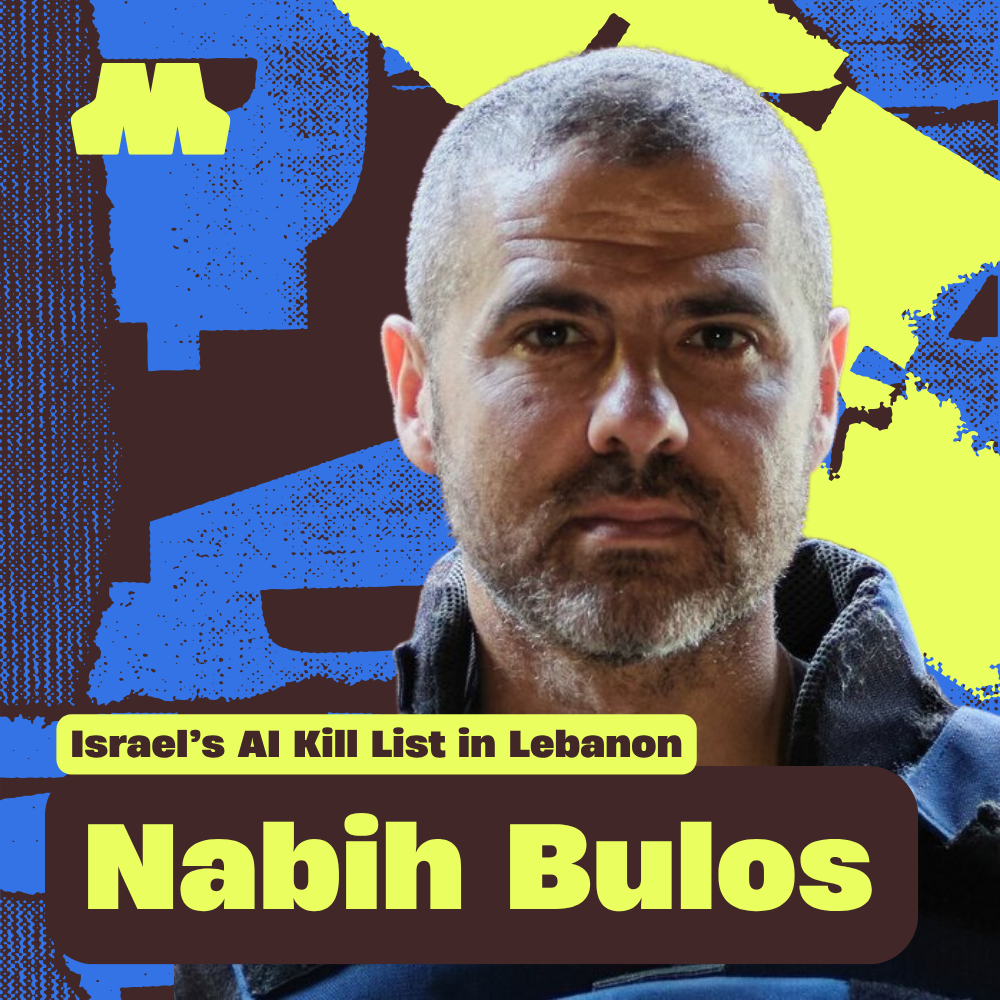
The Israeli military is using data, surveillance, and AI to kill noncombatants in Southern Lebanon.More like this: Computer Says Kill: Collapsing the Chain w/ with Matt MahmoudiThis week, we're kind of taking a break from our Computer Says Kill series to play a interview from our YouTube channel that is extremely relevant to the conversations we've been having about AI and militarization. Alix sat down with Nabih Bulos, the Middle East Bureau Chief at the LA Times, to discuss his recent reporting on Israel’s complex system of surveillance-driven targeting where, as he writes, even data from a phone can become a death sentence.Further reading & resources:
- Inside Israel’s AI targeting system: How data from a phone become a death sentence — Nabih Bulos, The Los Angeles Times, May 2026
- Watch the interview on our YouTube channel
- Catch up on episodes of Computer Says Kill, our series on AI, warfare, and power
**Subscribe to our newsletter to get more stuff than just a podcast — we run events and do other work that you will definitely be interested in!**
Computer Says Maybe is produced by Georgia Iacovou, Kushal Dev, Marion Wellington, Sarah Myles, Van Newman, and Zoe Trout
Transcript
Alix: Hey there, I'm Alix Dunn, and welcome to Computer Says Maybe. I wanted to share an interview that I did over on YouTube in video land, and it feels really connected to the Computer Says Kill series, so we decided to pull it over here to our main feed. The interview is with Nabih Bulos, who is the Middle East Bureau Chief at the LA Times, and he just published shocking reporting.
It outlines how the Israeli military is using data surveillance and AI to kill non-combatants in southern Lebanon, and he doesn't pull any punches about his analysis of what that means in terms of Israel's expansion of essentially just going into whatever country they want to go into and doing whatever they want, war crimes or not.
And in the Computer Says Kill series, we've talked a lot about how AI systems are being deployed, and some of it can end up feeling a bit abstract. Like I think we can all get upset about collapse of accountability and the use of technology that we know doesn't work consistently in such high-stakes contexts.
But this story that Nabih covered, it just brings into focus what it means for people living within these systems of control and warfare. And so we wanted to share it with you guys who may be listening to this broader series. So let's jump into it with Nabih Bulos.
Nabih: So I'm Nabih Bulos. I'm the Middle East Bureau Chief for the Los Angeles Times, and I am based in Beirut, where I've been for the last 13 years. I mean, this was someone who was sitting in his brother-in-law's house. He gets a call, and the call basically is an Israeli military officer or intelligence officer, and they're telling him, "Ahmad, do you want to die on your own or with your family?"
That was it. It's bone-chilling. And he says alone. Yeah. Yeah, and, and hangs up. But as you can imagine, it's a very sort of powerful image. I mean, just to imagine this person sitting with his family in this situation And he hangs up. You know, his family sees that he's very, you know, distraught obviously.
And when he tells them, they initially actually try to help him, right? They start tell him, "Okay, we can like maybe cause a diversion, or we can make you dress up in women's clothing, go out," et cetera. He just says, "There's no point," right? I mean, technology is just too powerful. They know my face. You know, there's no question that, that he would be bombed, and the only thing that would happen is that basically his family would also be killed.
So then he just goes out. He sees his wife, and, uh, he ignored her. He didn't say anything. She started talking to him, but he ignored her just so that she wouldn't stop him or anything, and just goes straight to his car. Maybe five seconds after he starts it up, just these two missiles come and, and they blow him up.
Alix: How did you kind of reverse engineer what led to that moment in terms of Israeli intelligence, the underlying infrastructure that might have enabled Israel to take this kind of a controlled action and I guess execution?
Nabih: First off, it should be said that Ahmad Termos used to be a fighter, right? He used to be a Hezbollah fighter in his youth.
And then as he grew up, as he became older and retired, he became what is known as a rabit, a liaison. Now, Hezbollah, it should be said, is not just a military force. It also has a powerful political and social component, and that means taking care of the infrastructure in the villages that are, let's say, affiliated with Hezbollah in terms of a political entity.
And so, you know, in this case, he basically was involved in, well, in helping rebuild the village he was in, right? This was a village in South Lebanon in Talluso. And this is actually quite close to the Israeli border and had been destroyed in the last few wars. And so he was involved in rehabilitation, water, electricity, et cetera.
And he had just come back from a meeting with Hezbollah members and also other municipal figures, right, to talk about the situation in the village, and then that's when the call came. Now, how I sort of reverse engineered this. Now it should be said, Lebanon has in many ways already been penetrated, right?
We've seen this time and again over the last few years especially. Now I should add that nothing on its own is necessarily revolutionary, right? This idea of collecting this much data, whether that's from drones or from phones or social media, right? Right. We've heard about this for really a decade at this point, right?
From Snowden and others, right? So we know that this is possible. The difference is really is that you have this AI sitting on top of all that data, but, you know, I'll get to that in a second, right? The way that I sort of understood all this stuff to be happening is that, for example, so Lebanon's phone database, you know, the phone lists that you have for the two main phone providers in the country, right?
Those were apparently handed over really back in two thousand and five, two thousand and six, I believe, right? After something called the Special Tribunal that was for a trial to basically capture Hezbollah members who were accused of assassinating a certain politician in the country. And so I was told that even then, all that database was already sent abroad and therefore almost certainly leaked to the Israelis.
But then you also have things that are structural. I mean, for example, maybe about 10 years ago, right? You could actually send a message on SMS with a license plate number, and you could then actually get the full information of the car owner, of the vehicle owner. So that database was also, you know, obviously all over it up Then you tack on this idea, right, that the Israelis now have these drones, you know, that are really actually constantly above Southern Lebanon, just all the time.
And of course, you know, they themselves can act as cell towers, right? They actually have a stronger signal than the local cell tower signal. And therefore, that just, you know, Hoovers up the data, the IMEI of the phone, right, the IMSI, and all this other information, which means that now even if you switch SIM cards, you would still be tracked, right, across various phones.
In fact, if you frequently switch phones, that would actually add to your threat profile- Yeah ... based on this metadata-driven analysis that we're talking about. Then you also have to tack on the fact that, for example, you have actually quite a few instances where the Israelis managed to hack into security cameras.
So you have a security camera in front of your house or what have you, right? They were able to hack into those because actually most of them are a brand, I believe it's called Danwei, it's a Chinese brand, and there've already been quite a few documented hacks into these cameras, right? And of course, you add on ALPR vision, all this other stuff, you know, to read license plates, et cetera.
And with all that, you can actually create a fairly detailed pattern of life for anyone you want, especially in Southern Lebanon, where really you have at least two drones in the sky at any point in time, especially over the last two years now. You know, if you combine all that information, Ahmad Tormos was a known figure in the sense that he was a figure with Hezbollah, right?
You had this drone above him all the time for really a year plus. You have also the ability to hack in security cameras, and they can Hoover up all the cell phone data from his phone and others. I mean, they have access to the TETRA network. TETRA is the network for civil defense and emergency workers and police.
So that too was apparently hacked. And finally, there have been actually quite a few documented instances of spies in Lebanon who have actually gone around the country with RF scanners and have, you know, just a breakdown of all the various networks and frequencies you have in the country. So all this is to say that the country's quite penetrated.
I mean, none of this is, uh, smoking on its own, but taken together, you can start to big picture.
Alix: So you, I think, have this picture of just a vast amount of data collection at every level, at the level of individual, at the level of geographic, um, relationships, at the level of, I don't know, like up-to-the-minute everything.
Um, that's a lot of data, but a lot of data doesn't necessarily turn into insight. Do you wanna describe a little bit about the difference maker or sort of how Israel has been deploying AI on top of all of this massive amounts of data collection?
Nabih: Well, sure. It's a huge, huge, huge advantage. I mean, just to give you a sense of this, right?
Back in the day in the Iraq War, you would have, for example, 2,000 analysts working with all this data, just sifting through all this data to be able to come up with a targets list of some sort. And let's be clear, this was not a very extensive target list, right? You know, you would have a situation where you had all these air assets and they didn't have enough targets for them.
That's not the case with Israel, right? Israel actually has been talking about a full AI suite, right? Not just the ones we've heard about in, you know, in the reporting from 972 Magazine and others. You know, you also have a situation where Even for something as simple as fire control or other things, all this is done now via AI.
And it's been talked about since early 2023 before the Gaza war, let's be clear, right? That's been the main thing, because now you have this ability of a group, for example, like Palantir, to go in, tag, and score all this data, right? And then what the AI does, it basically is a function of pattern analysis, right?
Mm-hmm. You feed the AI or you train the AI on previous instances of attacks, right? Or on profiles of known, you know, militants or figures, right? Mm-hmm. Or, you know, you do things of that nature. And through that, right, with that, uh, sort of pattern fed into the system, it then goes and takes all this data and tries to pick out other patterns.
You know, that's been a huge thing in this case, and the Israelis boast about it all the time. I mean, I found this Israeli military article where they talk about how this happens within seconds, right? I mean, it's not even minutes. I mean, they feed just this huge phone list into the system, and it spits out Possible militants with a pretty high level of probability, you know, apparently
Alix: With scale, I would think would introduce inaccuracy and also a level of cold, calculated, essentially as- assassinations where there...
It, it's not we're looking for this person, or we would like it if this person died in some type of skirmish. It's, we have this person on a list, and we also have the capability of, with precision, killing them. That feels like a step change that's distinct from generating more target lists so that you know where to send your air assets.
So like, where do you think the threshold is for Israel in terms of knowing someone is actually a combatant, making the decision that they are a threat in a way that would justify them taking lethal action? It feels, I don't know. Where are we seeing the decision points within these systems where historically there would be a human making a determination as to whether or not it was appropriate, or is, is that lost in this?
Nabih: Well, so a few things, right? I mean, it's also important to note that these are basically LLMs at play, right? And we know, right, that LLMs have- Which
Alix: are bad technologies.
Nabih: I mean, these have a built-in factor of error- Yeah ... right? And, and, and this cannot be fixed up. I mean, they've been talking about sort of scaling up, and therefore reducing the error.
And the fact is, you know, if ChatGPT gives me the wrong information about how to make a cake, that's one thing, right? But if ChatGPT then tells me this guy is a militant when they're a farmer or whatever, then that's a different situation obviously, right? Now, that's one aspect of it. You know, there are others.
The fact is that, you know, you also have a situation where the Israelis can decide how much collateral damage is acceptable based on the value of a certain target that they're after. I mean, I spoke to one person who I didn't mention in this article 'cause I couldn't just confirm what he had been saying, but, but he was saying to, you know, to me before that the difference between the American use of AI versus the Israeli use of AI is that the Americans tend to be more careful about collateral damage.
Now, we can talk about how right or wrong that is, but it's a matter of levels, right? I mean, you can say, you know, that you are accepting, let's say, five people, right, within the sort of splash radius of the ordinance to be killed, whereas others would say, "Okay, 20 or one," or whatever, right? Now the Israelis, we've seen instances where you have 200 people being killed in the name of getting a target.
Now, in another one we haven't seen that level, of course, but- You know, this idea of who is militant and who's not. And in fact, there's a paper, and, and this is beyond even a matter of AI, right? If you simply rely on metadata, right, to decide if someone is guilty or not of a certain act, right? You start to enter, you know, very much into Minority Report territory, quite frankly,
Alix: right?
Yeah. It's non-deterministic. You're essentially guessing. Yeah.
Nabih: Yeah, exactly so. And it should also be said, right, that, that at the same time, you know, this stuff can be happening just in terms of, you know, something as simple as co-location. For example- Mm-hmm ... let's say that, you know, like my house is a known Hezbollah tunnel, right?
Then anyone walking past my house is tagged by this system, right? I mean, that puts them within the, let's say, the, you know, the eyesights of this system in the first place.
Alix: Mm-hmm.
Nabih: Then the system starts to track them, right? It might dedicate more resources to tracking them. It starts to build a pattern of life.
Let's say this person sleeps at 11:00 PM and wakes up at 7:00 AM. Well, one day they woke up at 2:00 AM and drove towards a certain area that is known to have a Hezbollah tunnel. That increases their threat profile. And the way this goes is it's essentially a real-time updated threat profile. You know, my understanding, and again, I couldn't get a definitive figure as to the thresholds as to when someone is put into the tasking of an airstrike, but, you know, the idea is that all this is automatic up to the point where they are put in the tasking.
Once they're put in the tasking for an airstrike, that's when the final sign-off comes off, you know, from a human operator. But I mean, as we've seen in the reporting in other places, this is really essentially a rubber stamp situation. Yeah. I mean, we've seen it, you know, with people doing normal tasks, so this is very much the same way.
Alix: So why do you think Ahmad Tormos was targeted when you think back at this story? Like, do you have a sense of, like, what the threshold was given... Was it his history? Was it, like, why?
Nabih: So, you know, the day before his killing, he had turned off his phone, you know, he put it at home, right? And then the next day he went to a meeting with municipal figures, you know, that also included Hezbollah officials, of course, and his phone was still off and at home.
And then when he came back from the meeting, that's when he picked up the phone and, and he got the call. Now, it should be said Israel has been targeting Hezbollah figures who are not combatants for quite some time now. I mean, just as we saw with Hamas and Gaza, the idea is to sort of create, I suppose, an AI equivalent of the Phoenix program in Vietnam, where you basically assassinate all the support figures, right?
Not just fighters, but you know, the village elder, right? The village, you know, whatever. The idea being here is that you are denying Hezbollah its native operating environment. What that means in practice is that you're killing everyone, right? Whether they are civilians or whatever, and you are razing villages, which is basically what is happening right now in South Lebanon.
You know, my sense was that since he had gone to this municipal meeting and was involved in rebuilding the village, this was already a problem for Israel, and therefore he had to be killed, right? 'Cause he was the one who was liaising with Hezbollah and other villages in terms of getting them rebuilt.
Alix: Yeah, I mean, that sounds like a war crime. I don't know. That sounds, I mean, that, that level of threshold of participation in something that is in a country where the political parties and sort of official structures of governance are intricately connected, that fundamentally means that in Lebanon, in Palestine, in places where governance is structured in that way, that it would be acceptable to execute civilians.
Nabih: That's pretty much what is happening. The fact of the matter is that Hezbollah, again, is not a simple fighting group. Not everyone is a combatant. You have administrators, you have others, right? You have school teachers. I mean, it actually has a robust school system as well. So what does that mean? And you can think of it also in terms of, like, the US military, right?
It's, it's worth knowing, for example, right, that for every fighter there are three administrators. And you can bet that if you saw, for example, an attack on an office building with, you know, armed logisticians, people would probably be angry about it, right? Because they are not actual combatants.
Alix: Yeah.
Nabih: So, I mean, of course it is a war crime, right?
Right? There's no question. But I mean, as we've seen in Gaza- It is just a different situation when it comes to, you know, these non-state actors like Hezbollah and Hamas- Yeah ... even though they have a strong civilian component.
Alix: My last question is just y- this isn't your normal beat or AI isn't the sort of normal things you cover, but you do cover questions of power, questions of sort of political structures, um, in contexts that are extremely complicated and have huge implications for everyday people.
I'm wondering sort of what you learned in the process of this AI reporting that you might not have known about, or sort of if you use the lens of your more traditional reporting, like how you see the developments with technology, both with Israel, but more generally AI in warfare.
Nabih: So I should say my focus is mostly on war, right?
And that's a function of my location, but also a bit my, you know, it's also my interest. And, you know, war's changed, right? Even war coverage has changed. We are talking about level of surveillance and the sort of panopticon feeling, especially in Lebanon, but elsewhere as well, where it just doesn't feel safe to be able to operate in areas near the front line because everywhere has become a front line.
Everywhere is surveilled, right? Before you could feel, you know, for example, that you were able to function, you know, within a certain margin, right? That feels gone now. I mean, again, the best way I think of it now is, is this idea of like Minority Report, where, you know, you can just sort of construct this image of someone and if it vaguely fits a certain pattern, right, regardless of anything else, then you're marked for whatever.
I mean, the main feeling I've had, and of course I should say this extends to other sort of elements involving AI as well. I mean, I'm a journalist, and obviously the job is at risk because of AI. That's clear, right? But with all that being said, this situation really sort of, I mean, it really crystallized for me how, you know, dangerous it is now to operate in places like Lebanon.
They're just so penetrated, and it's going to have to involve a real effort, I think, to combat this level of surveillance and this level of penetration in such a way that you can operate somewhat normally again. Um, and again, I'm, I'm not saying that I should do something nefarious or whatever. But just for like- Yeah
normal privacy situations. You know, there's something really very eerie about the level of control you can exercise here if you want to. You know, before you could, you could have some sense of guarantee of privacy within your home to a degree. You know, you put your phone off- Sure ... right? Whatever. You don't have a smart TV, et cetera.
You could figure out some way to achieve some level of privacy. Just feels like it's gone now, really. And, and- Yeah ... the fact is that, that, you know, increasingly it feels like you have to live like you're back in the Stone Age. You know, I've already had this sense before this story, but especially after it.
I'm increasingly after dumb items. I don't want a smart car. I don't want a smart TV. Right? I'm thinking of getting an old Nokia and just using it when I'm in the field. I just don't want any kind of modern accoutrement that's gonna put me at risk. Yeah. And it feels like everything is. And that's an awful feeling, I have to say.
Alix: Yeah. Agree. Okay. Well, thank you for this story. It was really eye-opening both- In terms of how the technology's being used, but also what's happening in Lebanon and how brazen Israel is growing in a way that feels it must stop when it stops, uh, no one- We might say that, you
Nabih: know, America hasn't stopped it is the fact.
And the fact is that, you know, you can't say that you are providing a calming, uh, impact on a certain party if you give them all the weapons all the time and endless intelligence support. Uh, there needs to be some consequences for actions, but I'm not holding my breath, unfortunately.
Alix: Thanks so much for listening to this episode. I'll also say if you liked it and you like watching videos on the internet which I know is not everyone's bag, um, we dropped a link to the video in the show notes. And if you're interested, we are gonna be sharing more as we try and find ways to cover complex topics like we do on the podcast, but in video form, hopefully for audiences that might not otherwise come in contact with these ideas and this kind of political analysis.
And we're in new pastures, like this is very new, uh, to us to do video. So if you're a regular listener, the best thing you could do to support the show is go over to YouTube and subscribe and share with people that you think would be interested in what we're cooking up. So do check that out. So we'll return to our regularly scheduled programming with Computer Says Kill on our normal Friday publication day.
And as usual, I wanna thank Georgia Iacovou, Kushal Dev, Marion Wellington, Sarah Myles, Van Newman, and Zoe Trout for working to produce the episode, and we will see you next time.
Stay up to speed on tech politics
Subscribe for updates and insights delivered right to your inbox. (We won’t overdo it. Unsubscribe anytime.)

