


Show Notes
You can’t build a digital rights movement if you don’t know what you’re fighting for. Luisa says that we’re in a crisis of imagination, and that participation — the non-performative kind — is one big way out of this.
Further reading & resources:
- Learn more about Equilabs
- Follow Luisa on Instagram — sorry, email is too ‘analog’
- Check out her Linktree
**Subscribe to our newsletter to get more stuff than just a podcast — we run events and do other work that you will definitely be interested in!**
Post Production by Sarah Myles | Pre Production by Georgia Iacovou
Transcript
Luisa: L-U-H-F-M on Instagram. But you know, you can also use analog terms like—
Alix: Love it. I'll write you a letter.
Luisa: Write me an email maybe.
Alix: Yeah. I love that. Email is analog.
All right. We were at MozFest last month. I had some amazing conversations, which we are releasing on our feed all this week if you missed MozFest. We also made a special episode that hopefully will make it feel like you were actually there, and that's on the feed right now. So if you haven't heard it, go back and give it a listen.
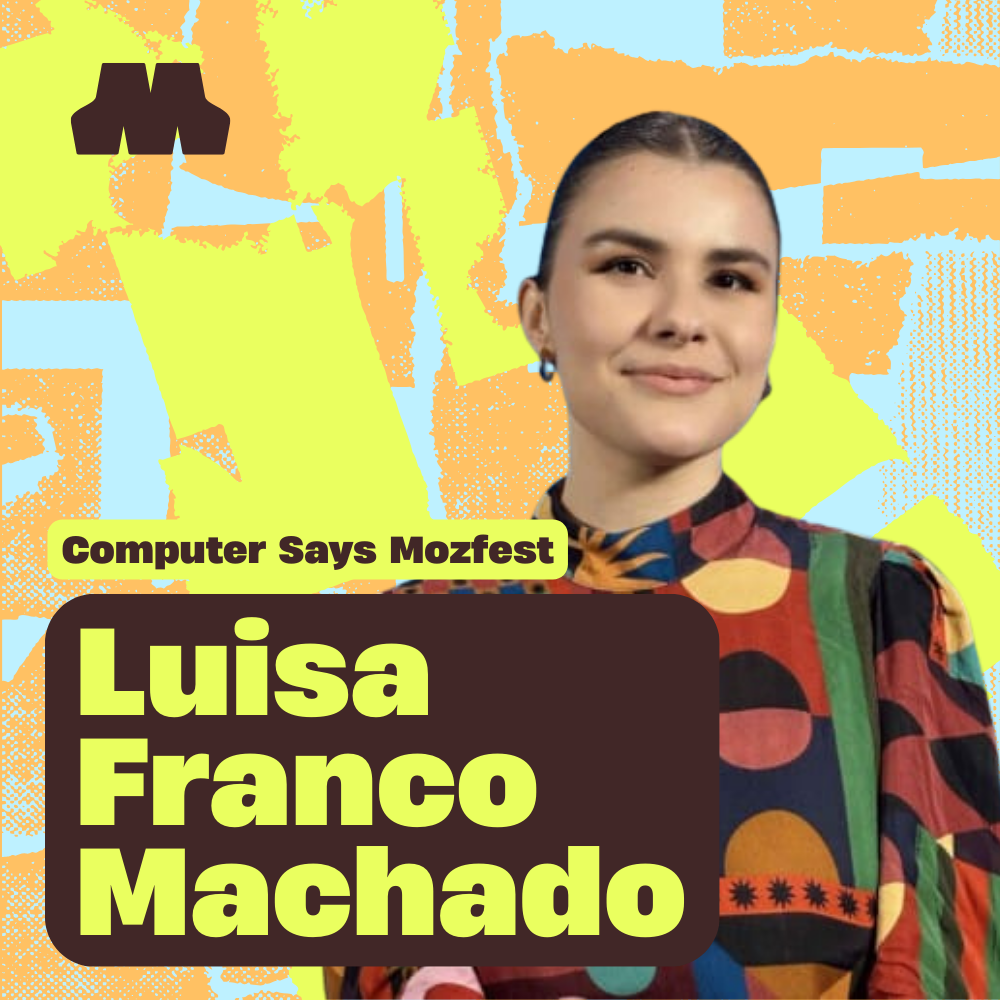
Here is Luisa Franco Machado to talk about EquiLabs, a digital rights movement that's hopefully gonna pull us out of this crisis of imagination by instigating some intergenerational conversation about what we want in the world.
I am here with Luisa who works a lot on, if I understand correctly, how badly sectors of power like AI and technology and governance engage people that are under the age of like 50 would be my, the line I might draw. And tries to build structures that increase both the pressure for that to happen, but also the kind of channels and opportunities and methods.
Is that a fair?
Luisa: Sounds like a good description, not just of my work, but actually what we're dealing with, right? As a society, as people, I think we all feel. Slightly disengaged with the idea of changing the technology world in this space. I think all of us are super engaged and empowered, but actually most people feel extremely disengaged with how tech decisions are made with how AI has been rolled [00:02:00] out with the use of governance of artificial intelligence and other technologies.
But especially when we talk about. The youth, like young people, the next generation, everyone loves talking about the next generation, but I'm not sure they like talking to the next generation. We love talking about what are the digital futures we want to create for the next generations, but actually what are the futures that these generations are already building and creating and advocating for?
So this is sort of the mission behind Equi Labs and the movement that we're building that is. Youth led at the core, but it's also intergenerational because we want everyone on board. So do you wanna describe what Ecolab does? Yeah, so Ecolabs is a digital rights laboratory, and I know this sounds, yeah, I know this sounds a little bit confusing maybe, but we wanna work with the idea of imagination.
I feel like. The tech systems [00:03:00] that we're dealing with. They are the way they are because we are living a crisis of imagination. We cannot imagine what technology can be beyond capitalist interests. So Ecolabs is there to sort of reimagine this world. And we do research, we do advocacy, we do movement building and actually engaging young people to actually have a say in technology decisions and.
Tech policies and more in general participation in the global sphere, both locally and internationally as well. I
Alix: really like that as a frame. Not least because I think there's been an emphasis on the word performatively participation. So this idea that like ev, everyone should be able to participate.
But oftentimes my next question is in what? And I think this idea that saying let's participate in a capitalistic exploitative system is like, not really. Yeah. It's kinda like when people are like, oh, we should get more women into tech. And it's like, oh, but don't the jobs suck in their being like their toxic work [00:04:00] environment.
Don't worry. Yeah. We should just get more women into those jobs. It's like, I don't,
Luisa: why, why would you do more? Why do we wanna sort of use the same systems that have been using us and you know, we're never gonna get forward if we continue accepting these systems. Oh my God. I can talk so much about the whole women and p um.
Thing. I mean,
Alix: it's a lack of imagination, but it's also, I feel like this defeatism that we just kind of have to accept that most of the world and the way the world is, is will just always be that way. So what do we want to change about it? Recognizing that very little can change and that just feels. Like, I think if there's one positive over the last few years, in addition to the kind of depressing trajectory of everything, is it because everything's blown up in this way?
It makes me feel like what I maybe previously thought was impossible is now possible because anything is possible and it's just been like. Stuff, but
Luisa: like that must mean also that good stuff. Yeah. Is possible too. And, and I really hope that more people sort of start becoming aware [00:05:00] of it, right? Because if you wanna build a movement, a digital rights movement, we need to first understand what we're fighting for.
I think that, you know, unlike the climate movement that has really. Strategic demands, you know, lower emissions. I think like in the digital rights movement, there are so many aspects at play that we sometimes have a hard time understanding what are we actually demanding and to whom? And then from that, this utopia, okay, how can we sort backtrack and understand how do we actually get there, be it through policies, be it through.
Corporate changes or participation or citizen engagement. There are so many ways to get to these sort of digital futures. We want, and especially, you know, being from the Gen Z, which is a generation that, you know, has been sort of in the middle of all of these digital changes, and we're also expected to have the answer.
What I've been seeing is so many [00:06:00] young people actually going through a phase of first addiction. You know, the same way that happened with social media. I see a lot of young people addicted to chat, GPT and AI and sort of, you know, there are so many like memes about how we cannot have a conversation without going through chat GPT first and double checking if what we're saying is right.
And then I think that this has been leading to sort of a. Huge disengagement with AI where a lot of young people are actually saying, if your company or your government or my government is actually using ai, I'm gonna purposefully not engage with it because I don't wanna support ai. But what does this actually mean?
Like why are people feeling so skeptical of these new technologies? It's because they don't feel like anything that they feel or live through them. Actually matters if it's not profit making. So we really need to find new ways to sort of engage people and young people, but you know, older folks alike all generations to actually feel [00:07:00] like they have say in this and it's not gonna happen just out of the blue.
We need a movement. One of my questions in
Alix: preparation for this, I was gonna ask you, do you like technology? And I don't mean it as like a, oh, you work on making it better, so you must hate it or something, but more just like, I feel like if I was. A younger person right now. I would hate it. Like I, because, because when I first started experiencing technology as a young person, it was like an optional playground of things to explore.
And then it became this like oppressive structure that you're required to operate within in a two, a generation and a half. And like if I was, you might've hated, but like how do you, how do you feel about
Luisa: technology? I feel like I'm really a product of my generation in this way of like, I definitely feel like I depend on technology to exist.
I feel like also my work is very tied to technology. A lot of my advocacies through. [00:08:00] Social media and actually a lot of young people are, you know, social media activists that we touch a lot of people by posting our insights on TikTok or Instagram. If you decide to disengage and say, I'm gonna delete all of my accounts.
You're actually gonna miss out on a lot of opportunities to connect and to have a say in this movement or any movement that you want to participate in. So I definitely feel like I have this sort of like, almost like toxic relationship with technology. I really. Criticize these systems, but I'm actually deep inside of them and then it's kind of, oh, this is my research topic, but it's also something I'm personally engaged with.
So I think it's this sort of juggling between the personal and the political and the personal is political, so I don't think there's a direct answer to that, but it's definitely a product of all of the societal struggles we've been dealing with lately. Yeah, totally.
Alix: Well, taking a step back in terms of participation, AI is notoriously [00:09:00] bad for being inclusive.
There's this, and we're gonna democratize it by basically launching a product that a billion people can use overnight. And then everyone, let's see what happens. Yeah. Which like, I guess is participation, but at the same time, it also. Sometimes it's indistinguishable from experimentation on people, which I feel like is not the same.
Yeah, no, it's not the same thing. We don't
Luisa: past subjects. Yeah.
Alix: And then also there's this kind of, I don't know, like fetishization of expertise in AI spaces where like there's 10 dudes who all make like $10 million a year or whatever making these technologies. Um, and then everybody else is an idiot 'cause they don't know anything and they can't be involved because like, you know, like listening to Eric Schmidt be like, not even policy makers can be involved.
It just should be the technologist. It's like Exactly. You can't. See her face. But, uh, there's deep agreement here, um, and disgust maybe with Eric Schmidt. Um, but so, so the participation frame, I feel like the way I've seen it used is oftentimes this like cosmetic. Thing where it's like, oh, well yeah, we should have like people able to participate or [00:10:00] something.
Um, but obviously there are meaningful ways that people can participate. Do you wanna talk a little bit about that tension between like artificial constructs of participation and like genuine participation? Mm-hmm.
Luisa: Yeah. I think that we are sort and, and era, and I don't think this is new. I don't think this is specific to this time, but I think now it's maybe more visible.
It's sort of like. Demand for experts when we are dealing with a problem. Um, I have most of my experiences in the public sector be in governments or international organizations. When we have a problem, we seek experts, right? So AI governance experts or data privacy experts or climate justice experts to sort of bring the, the solutions, the answers to the problems, um, that we're all dealing with.
That were created by experts. That's a good way of saying Yeah. And when we sort of, you know, value expertise to this level, we [00:11:00] actually leave out most of the population, the people that are actually struggling. With these problems, with these systems. So it's kind of like, how do we actually use research?
Because I do think that there is a value to research and a lot of the issues we are struggling with have been studied and you know. The whole evidence-based movement or discussion. I do think that there's a lot of value in it, but it's sort of like how do we bridge that with actual, you know, insights that people bring from their everyday lives and sort of evidence that might not be accepted in the sort of academic sphere because it's not a structure of evidence, but actually brings a lot of insights into the work.
We do. So it's kind of like how people live through the technologies we create or how do these policies actually affect people in a certain area of a certain demographic. I think that these are sort of the participatory ways that I would like see emerge and the downplay of [00:12:00] bureaucratization. I think a lot of social systems and participatory mechanisms have been super bureaucratized.
For instance, something that in in participatory mechanism governance. Work. A lot of people talk about citizen assemblies, so how can citizens sort of get together and make decisions about their community? But the reality is if you're making a citizen assembly at. 8:00 PM on a Tuesday after, you know, someone worked their entire day, they might not wanna participate.
And then it's gonna be seen as sort of, oh, the citizens are disengaged, they don't wanna participate.
Alix: Well, no, it's, or you get a small minority of people that are really engaged. Yeah. And it distorts what the public actually thinks about something.
Luisa: Exactly. So I think we're not, but counting for the different realities of possibility, you know?
So if you want. People engage in participating, you have to lift weight out of other aspects of their lives, you know, and here obviously we enter into a much more complex and deep conversation on sort of the [00:13:00] capitalist terms of work and what's expected of a, an adult or even a child in terms of, of what they have to deliver on their everyday life.
So yeah, maybe at the end of the day you just wanna sort of like doom scroll, you know, which is something we all do and that takes away our agency. So. I would love to think about alternative ways of participation. And a while back when I was working in this project with the government of France on how to get more young people to sort of participate in open government, and one thing that we started doing is that we started doing Instagram posts.
Very basic, and obviously that's not a structured research, but everyone votes on Instagram posts, you know, it's not that deep. And then we got so much more participation and many more answers in these Instagram polls than if you do an actual sort of poll and a website that people have to go to. You have to go where the people are instead of asking the people to go.
Towards you. And I think that's how we improve [00:14:00] participation.
Alix: So if I do this Instagram poll and I say in it, I hate AI and I never want to have to engage with it, and then our tech overlords and government are gonna be like, Hmm, that's really good feedback, but, uh, here's some ai. Yeah. So like, how do you, how do you feel about understanding the extent to which participation is actually meaningfully incorporated into decisions?
Luisa: I think that, first of all, the decision makers have to understand what's at stake. So a while ago I talked about shadow banning at the un, and I'm sure no one there that was listening to me ever heard of the term shadow banning, which is a deep problem to participation because it's kind of, you know, you're excluding voices.
From the social sphere, um, and it's a corporation that is doing that. Once we understand that, that's a stake, that can be part of what we're demanding as a movement, right? So I keep going back to the movement building because I don't think we can do this alone. And I think that that's why a lot of us feel disengaged because we're trying to do all this alone and that [00:15:00] feels very lonely.
Feeds into the mental health crisis. There are so many problems. So it's like how do we actually unite our demands and our problems and actually. Ask for a solution or design a solution and have our voices heard. So there are so many ways to actually change the world, I guess.
Alix: I love, I mean, how did you choose this to be one of the ways that you tried to change the world?
Like how did you get, how did you get into
Luisa: this? It was actually, so I'm originally from Brazil and in 2018 we had this election. The president was elected through social media. Right. So through a huge social media campaign, just like Trump the, the worst kind of social media. Yeah, the worst kind of social media.
And just like Trump had done before, Bolsonaro did that in Brazil. And I think that that's when I was like, oh wait, this is so impactful, but no one is actually paying attention to it. So that was back in 2018. So quite a few years have passed and I've seen this field sort of developing and, and I like what has happened because since then we have.
[00:16:00] So many more actually regulations, um, all around the world regulating social media, but also ai. And you know, I do see a lot of progress in the sense, but we can't stop there because technology keeps evolving. So, you know, our policies have to evolve just as fast. Um, and then my wild
Alix: card question for you is, if you could be born at any time, when would you be born?
Would you wanna be younger now or older now? Do you kind of wish that you'd miss. This weird moment of Tech Empire and like, I don't, I don't even know what we wanna call this kind era, but I presume it will end eventually. Do you wanna be born after
Luisa: it? Do you wish you were born earlier? Honestly, I think I'm a product of my time.
I love being Gen Z. I love what it represents. I love no change. I love being able to sort of bring a lot of also identity aspect into it, right? I'm always saying, okay, why do I think young people are so transformational when we are in policy making spaces? [00:17:00] It's because we're not afraid of. Naming the core problems, what, you know, naming sexism, naming queer phobia, naming racism, and how this actually connects to our systems.
So I think I'm very much a product of my generation and I think I wouldn't wanna be born in, I'm into it. No. I just, I just
Alix: feel so, I sometimes feel bad for. Like your exact age group. 'cause I feel like you both have higher expectations than generations that have come before you. And then also maybe that's it actually, you have high expectations.
We have and like everything's so shit that like the gap between your expectations and the reality is so great. Which I imagine is motivating for people like you who get into this kind of work. Mm-hmm. But for people who are just working like a normal job. Yeah. Right now it would kind of suck. And I also feel like.
I don't know. When I think about ai, I think about. The only thing we do know about the way it's affecting people's futures is it's making it really hard for people in their twenties to get those first experiences and like understand [00:18:00] what career they want to take because people are, want to hire robots rather than people, which is like another disgusting part of capitalism that I will never understand, like not wanting to work with people.
Luisa: But I do think that we're sort of, I hope at least we're walking towards. A direction where a lot of people are already talking about like the AI bubble and how that's gonna burst. And, and I do think that, I think we're about to see a sort of return to analog terms the same way that, you know, analog cameras are super popular right now.
I think that people are sort of craving more analog ways of connecting to each other and, and to the systems around them. I'm not saying we should have, you know, like papers. To sign up for government benefits. Like, no, I do think like bureaucracy really benefits. Yeah, digital's nice. Yeah. From technology.
I'm not a tech hater. Um, but I do think that a lot of things that we value about human connection are getting lost and a lot of people are feeling it. A lot of people are feeling really lonely, you know? And the loneliness crisis. Hopefully will make people sort of [00:19:00] take a step back and connect to each other.
You know, they're sort of logging off, clubs, popping around. And um, I think also the work that EQU Labs is doing, gathering young people to sort of rethink and recreate the digital futures we want, and sometimes. The digital future we want is not using technology for certain things. Totally touch grass, you know?
Yeah. Touch grass. Like go talk to your friends, like meet your neighbors. Like a lot of people don't even know their neighbors, and the problem is much bigger than just technology. I think technology is part of this wider capitalist system that is disconnecting us from each other and disempowering us in that process.
But I feel like there is a progress in this, in this sense.
Alix: Yeah,
Luisa: I think
Alix: you're right. Okay. Well if people wanna get in touch with you or get involved with EQU Labs, what should they do?
Luisa: They can reach out on Instagram. Love
Alix: it. Meet people where they
Luisa: are. I am not on Instagram. Um, you also can see our page.
We have a page, it's equ labs.org. Our Instagram, it's [00:20:00] equity dot labs. And also on my personal page, I post a lot about the activism that I do for digital, right. So it's L-U-H-F-M on Instagram. But you can also use analog terms like, love it. I'll write you a letter, write me
Alix: an email maybe. Yeah. I love that email is analog.
I'm into this, uh, 'cause I do feel quite antiquated that I basically only use email, but it is, I mean you
Luisa: can reach me out on tech now. Yeah. Great, great, great, great. Loving it. All these options. Okay,
Alix: cool. Well this is lovely. Um, I hope you have a wonderful. Coachella for digital rights. Is that what someone said to you that this is called?
Yeah. But this is great and thank you for all the work that you're doing.
Luisa: Thank you so much for also creating this platform for people like us to come and. Sarah, the mens, and hopefully say our demands
Alix: and hopefully, and then not be able to answer them. But I will,
Luisa: I'll listen to them. Keep asking questions.
Alex. Yeah, I'm here.
Alix: I'm here. Awesome. Okay. Well thank you. As usual, thank you to Sarah Myles and Georgia [00:21:00] Iacovou, and a special thanks to Mozilla for letting us take up space, uh, at their festival with a little recording studio and a little gazebo. And thank you for the audio engineering team that helped staff it.
It was very. Lovely experience coming up on the feed. Tomorrow is Audrey Tang.
Stay up to speed on tech politics
Subscribe for updates and insights delivered right to your inbox. (We won’t overdo it. Unsubscribe anytime.)

